Pre-Workout & Energy Drink Jitters: Why MOD Is Different
You downed a pre-workout or cracked open an energy drink and now your hands are shaking, your heart's racing, and the anxiety is louder than your focus. That's energy drink jitters, a well-documented side effect of flooding your system with high-dose caffeine in a short window.
The mechanism is straightforward: caffeine overloads your adrenergic system. Adenosine receptors get blocked, adrenaline surges, and your nervous system interprets this as a threat response rather than a productivity boost. Most OTC energy drinks and pre-workouts rely entirely on this pathway, and at 300 to 400 mg of caffeine per serving, they hit hard.
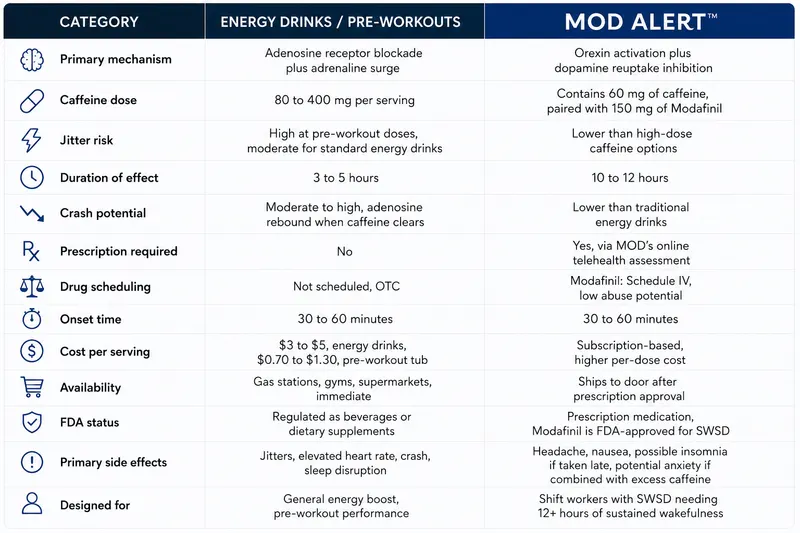
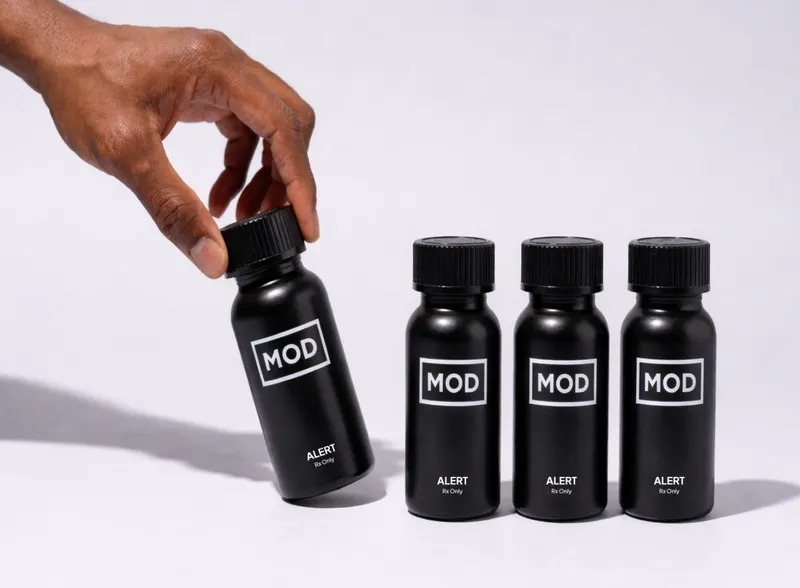
MOD Alert works through a different mechanism. It's a prescription medication drink containing 150 mg of Modafinil and 60 mg of caffeine. Modafinil is a wakefulness-promoting agent that operates primarily through orexin signaling and dopamine reuptake inhibition, not the adrenaline spike that causes jitters. It's designed to provide up to 12 hours of sustained wakefulness with a lower jitter risk than high-dose caffeine.
This article breaks down exactly why energy drink jitters happen, compares the full side-effect profile of both approaches, and helps you figure out which one fits your situation.
Key Takeaways
- Energy drink jitters are caused by high-dose caffeine triggering an adrenaline surge, not an unavoidable side effect of every alertness option
- Most pre-workouts contain 200 to 400 mg of caffeine per serving, the FDA cites 400 mg/day as a general upper limit for healthy adults
- Modafinil is described as having a generally milder side effect profile than traditional stimulants, though potential side effects can still include headache, nausea, anxiety, and insomnia
- Modafinil is described as providing long-lasting wakefulness support, with effects that can last about 12 hours
- Energy drinks win on price and accessibility, no prescription, available anywhere, $3 to $5 per can
- MOD requires a prescription through a telehealth provider and costs more upfront, but delivers longer-lasting results with a lower jitter risk
- People who tolerate caffeine well and only need 1 to 2 hours of energy are often well-served by a standard energy drink or pre-workout
- MOD is purpose-built for shift workers with Shift Work Sleep Disorder, or SWSD, who need consistent, extended wakefulness, not a casual pre-gym boost
Why People Look for Energy Drink Alternatives
The most common complaint: the jitters hit before the focus does. You crack open a pre-workout or energy drink, feel the surge coming, and instead of sharp focus you get shaky hands, a racing heart, and anxiety that makes concentrating harder, not easier.
Three other patterns drive people to look for something different:
- Diminishing returns. Regular energy drink use builds caffeine tolerance fast. What worked at 150 mg stops working, and the escalating doses needed to feel the same effect push users further into jitter territory.
- The crash. Caffeine's 5-hour half-life means the energy debt comes due. For shift workers who need 12+ hours of reliable wakefulness, a 3 to 5 hour boost followed by an adenosine rebound crash is worse than useless.
- Sleep disruption. A 3 PM energy drink still has meaningful caffeine in your system at 11 PM. Shift workers already fighting Shift Work Sleep Disorder can't afford to make sleep quality worse.
For people who just need a pre-gym boost, a lower-dose energy drink still makes sense. But for shift workers cycling through OTC options with worsening results, the pattern above is what pushes them toward prescription alternatives like MOD.
Quick Overview
MOD Alert
MOD offers prescription medication drinks formulated specifically for shift workers and people with Shift Work Sleep Disorder. MOD Alert: Modafinil 150 mg + caffeine 60 mg. Modafinil, the active ingredient, is a wakefulness-promoting agent that is FDA-approved for Shift Work Sleep Disorder. It promotes wakefulness through orexin or hypocretin signaling, dopamine reuptake inhibition, and histamine modulation, pathways that do not primarily trigger the adrenaline response behind jitters. MOD products are prescription medications, not FDA-approved products. They require an online assessment and provider review through MOD's telehealth platform before being prescribed.
Energy Drinks and Pre-Workouts
Energy drinks, Red Bull, Monster, Bang, and pre-workout products, C4, Ghost, Pre-Jym, are OTC products designed to boost energy, alertness, and physical performance. They work primarily by flooding the brain with caffeine, typically 80 to 400 mg per serving, which blocks adenosine receptors and triggers a stress hormone cascade. They're fast-acting, 5 to 30 minutes, widely available, and inexpensive. The tradeoff: when the caffeine clears, adenosine floods back in and the crash hits hard. High doses reliably produce jitters, elevated heart rate, and anxiety, particularly in sensitive individuals or anyone already approaching their daily limit.
Why Energy Drinks and Pre-Workouts Cause Jitters
Energy drink jitters are the shaky, anxious, heart-racing sensation caused by high-dose caffeine flooding your body's adrenergic system. Caffeine blocks adenosine receptors and triggers a surge of adrenaline, epinephrine, and cortisol. At doses of 200 to 400 mg, standard in most pre-workouts, this stress hormone cascade produces tremors, elevated heart rate, and anxiety that typically last 3 to 5 hours.
Caffeine's jitter mechanism is well understood. Caffeine is structurally similar to adenosine, a neurotransmitter that gradually slows neural activity throughout the day. When caffeine binds to adenosine receptors, it blocks adenosine, but the downstream result is a surge of epinephrine, adrenaline, and cortisol.
This adrenaline surge is exactly what you feel as jitters. Your heart rate climbs, blood pressure rises, and your nervous system shifts into a mild fight-or-flight state. At moderate doses, 80 to 150 mg, this can feel like sharpened alertness. At 300 to 400 mg, standard in many pre-workouts, it can feel like panic.
The two common delivery formats compound the problem in different ways:
- Energy drinks: Often consumed quickly and on an empty stomach, which speeds up caffeine absorption and sharpens the peak concentration spike
- Pre-workouts: Even higher caffeine loads, sometimes combined with other stimulants like synephrine that amplify the adrenergic response further
The underlying issue isn't caffeine itself at low-to-moderate doses, it's the dose and delivery speed. For people with lower caffeine tolerance, or anyone who's already had coffee earlier in the day, the jitter threshold arrives sooner than expected.
How Modafinil Skips the Jitter Pathway
Modafinil promotes wakefulness without relying primarily on the adrenaline pathway. Its mechanisms work differently:
- Orexin or hypocretin activation: Orexin neurons regulate sleep-wake transitions directly. Modafinil activates this system, promoting stable wakefulness without a stress hormone surge
- Dopamine reuptake inhibition: By reducing dopamine transporter activity, Modafinil increases dopamine availability, supporting motivation and sustained attention
- Histamine modulation: Modafinil increases histamine release in the hypothalamus, contributing to wakefulness through a pathway independent of adrenaline
In other words, Modafinil keeps you alert through brain chemistry associated with wakefulness and focus, not the stress response your body uses in a perceived emergency. You do not get the racing heart, visible tremors, or anxious overstimulation that come with high-dose caffeine overload. A 2012 review in PMC covers these mechanisms and Modafinil's overall risk profile in detail.
MOD Alert pairs this with caffeine, enough to support onset speed and work alongside Modafinil's longer action, while keeping the formula distinct from high-dose energy drinks.
MOD Alert vs. Energy Drinks: Head-to-Head Comparison
Energy Drinks and Pre-Workouts
Pros:
- Immediately available, no prescription or intake process
- Wide variety of formulations, including stim-free options
- Low upfront cost
- Fast onset, useful when you need energy in under 30 minutes
- Many pre-workouts include evidence-backed performance ingredients beyond caffeine, creatine, beta-alanine, electrolytes
MOD Alert
Pros:
- Built for extended wakefulness: up to 12 hours per dose
- Lower jitter risk, Modafinil's non-adrenergic mechanism avoids the adrenaline spike
- Consistent prescription-strength dosing with each order
- Modafinil is FDA-approved for Shift Work Sleep Disorder
- Lower crash risk than traditional energy drinks
- Entirely online prescription process, no in-person clinic visit
Side Effects: An Honest Comparison
Energy Drinks and Pre-Workouts
Side effects here are primarily caffeine-driven and dose-dependent. At 80 to 150 mg, most people tolerate them with minimal issues. At 200 to 400 mg, common pre-workout territory:
- Jitters and tremors: elevated adrenaline produces visible shaking in sensitive individuals
- Elevated heart rate and palpitations: cardiovascular stimulation is direct and proportional to dose
- Anxiety and restlessness: the fight-or-flight hormone state can escalate perceived anxiety
- GI distress: caffeine stimulates gastric acid and gut motility, causing stomach discomfort in some people
- Sleep disruption: caffeine's half-life is roughly 5 hours, meaning a 3 PM pre-workout can still affect sleep quality at 11 PM
- Energy crash: when caffeine is metabolized, adenosine floods previously blocked receptors and energy drops sharply
With frequent high-dose use, caffeine tolerance builds quickly. Stopping after a period of regular use produces withdrawal symptoms: headache, irritability, and fatigue for 1 to 3 days.
MOD Alert
Modafinil has a generally favorable side-effect profile compared to high-dose caffeine, but it requires honest disclosure of potential side effects:
- Headache
- Nausea
- Decreased appetite
- Anxiety
- Insomnia
- Dizziness
- Diarrhea
- Runny nose
It can also interact with certain medications, including hormonal birth control, antibiotics, antivirals, and antifungals. It is important to disclose all current medications during the intake assessment.
Track your total daily caffeine when using any Modafinil-containing product. MOD Alert already contains caffeine. Adding multiple cups of coffee throughout a shift can push total intake into the range where jitters and elevated heart rate become more likely, even with Modafinil's otherwise steadier mechanism.
Who Should Choose MOD
MOD is purpose-built for a specific use case: shift workers with Shift Work Sleep Disorder, SWSD, who need sustained, reliable wakefulness across a 12+ hour window.
You're likely a good candidate if you:
- Work rotating, overnight, or irregular shifts and struggle with wakefulness and focus
- Have cycled through multiple OTC options and still experience crashes, jitters, or inconsistent results
- Need consistent alertness for 10 to 15 hours at a stretch, not just a pre-gym boost
- Are willing to complete an online assessment and get a telehealth prescription
- Want a prescription-strength approach with medical oversight and consistent dosing
MOD is not appropriate for casual energy needs or for people without SWSD symptoms. The telehealth process exists specifically because Modafinil requires medical evaluation, that's a feature, not a friction point.
Final Verdict
Energy drink jitters are not something you have to accept as the cost of staying alert. They're a high-dose problem with a specific mechanism: too much caffeine, too fast, triggering an adrenaline surge your body interprets as stress.
For most people needing a quick boost for a workout or a couple hours of focus, a lower-dose energy drink, 80 to 120 mg caffeine, taken with food is the pragmatic option. Dial back the dose, and the jitters often go away.
For shift workers who need 12+ hours of reliable wakefulness, and who've been cycling through energy drinks with diminishing returns and worsening side effects, MOD approaches the problem from a structurally different place. It's not a stronger energy drink. It's a prescription medication drink built on different brain chemistry, with a wakefulness profile designed for extended alertness.
Consult your healthcare provider to determine which approach is right for your situation.
Choose your plan and get MOD shipped to your door →
Frequently Asked Questions
What causes energy drink jitters?
Energy drink jitters are caused by high-dose caffeine triggering an adrenaline release. Caffeine blocks adenosine receptors, which raises epinephrine and cortisol, producing heart racing, tremors, and anxiety, particularly at doses above 200 mg or in caffeine-sensitive individuals.
How do I stop jitters from pre-workout or energy drinks?
Reducing the caffeine dose is the most effective long-term fix. For immediate relief, water, light movement, and time help metabolize the caffeine faster. Eating before consuming caffeine slows absorption and reduces peak concentration. Avoid stacking multiple caffeine sources, coffee plus a pre-workout puts most people well past the jitter threshold.
Does Modafinil cause jitters?
Modafinil does not typically cause jitters in the same way high-dose caffeine does. Its wakefulness mechanism does not primarily trigger the adrenaline surge responsible for classic caffeine jitters. Potential side effects can still include headache, nausea, anxiety, and insomnia in some users.
Is MOD the same as an energy drink?
No. MOD Alert is a prescription medication, not an energy drinks. They contain Modafinil, a wakefulness-promoting agent that is FDA-approved for Shift Work Sleep Disorder, along with caffeine. They require an online telehealth assessment and provider prescription before being dispensed.
How much caffeine is in pre-workout vs MOD Alert?
Most pre-workouts contain 200 to 400 mg of caffeine per serving. MOD Alert contains caffeine paired with 150 mg of Modafinil. The lower-caffeine approach reduces jitter risk compared with many high-stimulant pre-workouts, while Modafinil provides the primary wakefulness effect through different mechanisms.
How long do energy drink jitters last?
Energy drink jitters typically last 3 to 5 hours, corresponding to caffeine's half-life of roughly 5 hours in most adults. Symptoms, tremors, elevated heart rate, and anxiety, usually peak 30 to 60 minutes after consumption and taper as caffeine is metabolized. Individual factors including age, liver function, body weight, and caffeine tolerance influence how quickly jitters fully subside.
Can energy drinks cause anxiety?
Yes, energy drinks can cause anxiety, particularly at high caffeine doses. Caffeine's adrenaline surge activates the same biological pathways involved in the fight-or-flight response, which can manifest as racing thoughts, restlessness, and heightened anxiety. People with existing anxiety disorders or low caffeine tolerance are most susceptible, symptoms are most common at doses above 200 mg per serving.
Do sugar-free energy drinks still cause jitters?
Yes. Sugar-free energy drinks still cause jitters because the caffeine content, not the sugar, is the primary driver of the adrenergic response. Removing sugar eliminates the blood sugar spike and crash but does not reduce caffeine's adrenaline-triggering mechanism. A 16 oz sugar-free energy drink with 160 mg of caffeine carries the same jitter risk as its full-sugar counterpart at the same dose.
Can I take MOD if I already drink coffee?
Yes, but it’s important to watch your total daily caffeine intake. MOD Alert already contains caffeine, so adding multiple cups of coffee throughout a shift can push total intake into jitter territory, even with Modafinil's otherwise steadier profile. Discuss your caffeine habits with your telehealth provider during the assessment.
This article is provided for informational purposes only and does not constitute medical advice. The information presented is not a substitute for professional medical advice, diagnosis, or treatment. Always consult your healthcare provider to discuss the risks, benefits, and appropriateness of any treatment.
MOD offers access to healthcare providers who may prescribe compounded medications for the treatment of excessive daytime sleepiness associated with shift work sleep disorder (SWSD), when clinically appropriate.
The featured products include compounded medications that have not been approved by the FDA. Compounded medications may be prescribed under federal law but are not the same as, nor are they generic versions of, any FDA-approved medication. The FDA does not review compounded medications for safety, effectiveness, or manufacturing quality of compounded products. A prescription will only be written if deemed appropriate after the digital consultation by the licensed medical provider. Individual results may vary.
MOD is not a compounding pharmacy but a telemedicine service that links patients to licensed medical providers.