Too Anxious on Caffeine? There's a Cleaner Way to Get Energy
If a cup of coffee leaves you jittery, heart racing, or weirdly anxious, you're not imagining it, and you're not alone. Caffeine anxiety is a real, formally recognized phenomenon, and more than 90% of Americans consume caffeine without understanding why some people experience it and others don't.
The frustrating part: the standard advice, just drink less caffeine, often doesn't work. Cutting back triggers withdrawal symptoms that mimic anxiety. Eliminating it entirely leaves you exhausted. And for shift workers or anyone operating outside of a standard schedule, fatigue isn't optional, energy is a work requirement, not a preference.
This guide breaks down exactly why caffeine triggers anxiety, who's most at risk based on genetics, how long it lasts, and, most importantly, what actually works if you still need to function at full capacity.
Key Takeaways
- Caffeine blocks adenosine receptors and triggers adrenaline release, mimicking the physiological symptoms of anxiety
- At ≥400 mg/day, anxiety risk spikes significantly, a 2024 meta-analysis found a standardized effect size of ~2.86 for anxiety risk at high doses
- Caffeine anxiety can last 3 to 12 hours depending on your metabolism, it's not quick
- Genetic variants (CYP1A2, ADORA2A) mean some people are wired to feel more anxiety from the same dose
- Pairing L-theanine with caffeine reduces jitters and anxiety while maintaining focus
- Prescription modafinil promotes wakefulness through different brain pathways and may offer sustained alertness with a lower risk of jitters than high-dose caffeine
Why Caffeine Makes You Anxious (The Mechanism)
Caffeine anxiety is a physiological stress response caused by caffeine's dual action: blocking adenosine receptors (your brain's natural calming signal) and simultaneously triggering adrenaline release. This removes the nervous system's natural brakes while activating the fight-or-flight response, producing racing heart, muscle tension, and restlessness typically within 15 to 60 minutes of consumption.
Here's what's happening step by step:
Adenosine blockade. Adenosine is your brain's natural calming molecule, it accumulates throughout the day and creates the sensation of drowsiness. Caffeine's chemical structure is similar enough to adenosine that it fits into adenosine receptors (A1 and A2A), but instead of triggering calm, it blocks the signal entirely. UCLA Health explains that without adenosine binding, the nervous system accelerates.
Adrenaline release. That acceleration isn't passive, caffeine also stimulates the central nervous system to produce and release adrenaline (epinephrine), directly activating your fight-or-flight system. The result is elevated heart rate, higher blood pressure, and muscle tension. In other words, caffeine doesn't just wake you up, it primes your body for perceived danger.
Caffeine enters your bloodstream and reaches your brain within 15 to 45 minutes, with effects peaking around 60 minutes post-consumption. If your dose was high enough, what you're feeling isn't a caffeine rush, it's a mild anxiety response.
The DSM-5 formally recognizes four caffeine-related disorders: caffeine intoxication, caffeine withdrawal, unspecified caffeine-related disorder, and other caffeine-induced disorders, which include caffeine-induced anxiety disorder and sleep disorder, according to Healthline. This isn't niche pharmacology, it's in the diagnostic manual.
How Much Caffeine Is Too Much? The Dose-Response Reality
There's no single threshold that causes caffeine anxiety, the relationship is dose-dependent. But the data does point to some meaningful cutoffs.
The FDA guideline is less than 400 mg of caffeine daily for healthy adults with no serious adverse effects. That's roughly two large cups of coffee. But a 2024 meta-analysis found that high-dose caffeine (≥400 mg) produced a standardized mean difference of ~2.86 for anxiety risk, a large effect. Even low-dose caffeine still moderately increased anxiety risk, the relationship is dose-dependent at every level.
For context, a 12-ounce cup of regular black coffee contains up to 247 mg of caffeine. At toxic doses (1,200 mg+), caffeine can cause seizures and dangerous cardiovascular effects.
Here's what different caffeine sources actually deliver versus the anxiety-risk reality:
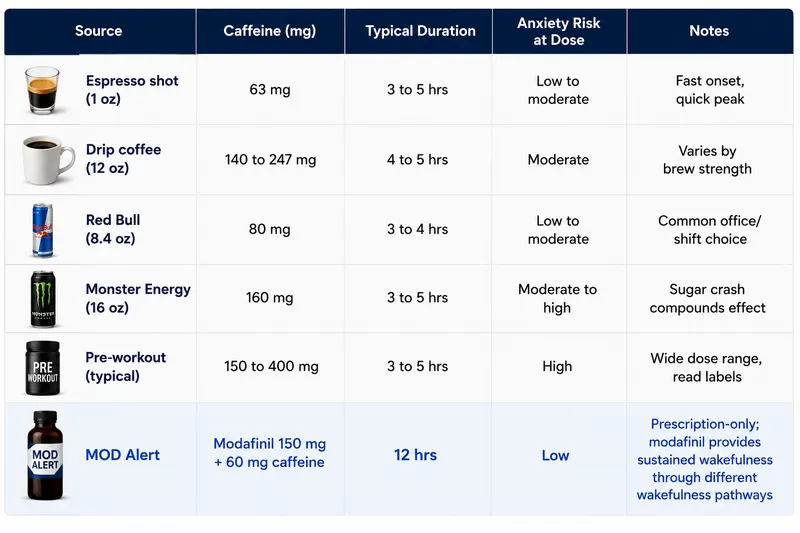
Prescription-only; modafinil provides sustained wakefulness through different wakefulness pathways
The pattern is clear: the higher the caffeine dose, the steeper the anxiety curve, and most everyday drinks deliver far more than people realize.
Why Caffeine Anxiety Hits Some People Harder Than Others
Caffeine sensitivity isn't about willpower or tolerance, it's largely genetic, and some people are biologically predisposed to feel more anxiety from the same dose.
Two genes matter most:
CYP1A2 enzyme variants. CYP1A2 is the enzyme that metabolizes caffeine in your liver. Slow metabolizers, people with certain CYP1A2 variants, break down caffeine more slowly, meaning it stays in their system longer at higher concentrations. The same 200 mg cup that a fast metabolizer clears in 3 hours might still be active in a slow metabolizer 8+ hours later, per UCLA Health.
ADORA2A gene variants. The ADORA2A gene controls the sensitivity of your adenosine A2A receptors, the exact receptors caffeine blocks to produce wakefulness. People with certain ADORA2A variants are significantly more prone to caffeine-induced anxiety because their receptors are more reactive to the blockade. This is why two people can drink the same cup of coffee and have completely different experiences.
If caffeine consistently makes you anxious, you're probably not overdoing it, you may simply have a genetic profile that makes you more sensitive to caffeine's effects. That's not something you can train your way out of.
The Caffeine-Anxiety Cycle: Why You Can't Just Drink Less
Here's the problem that no ranking article fully addresses: many people can't just "cut back on caffeine" because cutting back makes them feel worse, which leads to drinking more caffeine, which escalates the anxiety.
The cycle looks like this:
- Anxiety and poor sleep → chronic fatigue during waking hours
- More caffeine to compensate for fatigue
- Higher caffeine intake → adenosine blockade + adrenaline surge → anxiety symptoms
- Anxiety disrupts sleep → worse fatigue the next day
- Repeat
A 2025 systematic review in PMC confirmed that heightened caffeine consumption was associated with higher levels of psychological distress in a dose-dependent pattern, even independent of insomnia. That means caffeine is stressing your nervous system regardless of whether it's affecting your sleep.
This cycle is especially brutal for shift workers. Research published in PMC found that shift workers with higher daily coffee consumption reported higher perceived stress, longer working hours, and decreased sleep duration, the very conditions that make caffeine anxiety worse.
Cutting caffeine without addressing the underlying fatigue doesn't work. The fatigue is real. The solution has to address both.
How Long Does Caffeine Anxiety Last?
Caffeine anxiety typically lasts 3 to 5 hours in fast metabolizers, and up to 12 hours in slow metabolizers or people with liver conditions, based on caffeine's ~5-hour half-life.
Caffeine has a half-life of approximately 5 hours, meaning half of a dose is still active in your system 5 hours after consumption. If you consumed 300 mg at 8 AM, you still have roughly 150 mg active at 1 PM and 75 mg at 6 PM. The anxiety symptoms associated with caffeine, racing heart, muscle tension, restlessness, typically resolve as blood caffeine levels drop, which for most people means 3 to 5 hours.
For slow metabolizers or those with liver conditions, that window extends to 12+ hours.
Stopping caffeine entirely doesn't provide immediate relief, either. Withdrawal symptoms, headaches, fatigue, irritability, difficulty concentrating, typically start within 24 hours of your last dose and can persist for up to 9 days, per UCLA Health. In some people, withdrawal itself mimics anxiety symptoms, which creates the understandable misperception that reducing caffeine is making things worse.
What Is Modafinil and Why Does It Work Differently?
Modafinil promotes wakefulness through dopamine reuptake inhibition and orexin system activation, not by blocking adenosine receptors, which means it works differently from caffeine and may reduce reliance on high-dose caffeine in some people.
This is the key pharmacological distinction:
- Caffeine: blocks adenosine A1/A2A receptors → removes inhibition → causes stimulant-like surge → triggers adrenaline → anxiety symptoms
- Modafinil: inhibits dopamine reuptake + activates orexin system → promotes wakefulness through targeted neurological pathways
A 2004 PubMed study found that modafinil 400 mg attenuated fatigue comparably to caffeine 600 mg in sleep-deprived subjects, but modafinil's advantage was duration (12 to 15 hours vs. 4 to 5 hours for caffeine) and a substantially lower anxiety burden. The study specifically noted that modafinil prevented individuals from nodding off while maintaining a normal rested state of mind.
Modafinil is also a non-amphetamine wakefulness-promoting agent, meaning it doesn't carry the same addiction risk category as amphetamine-based stimulants. It's FDA-approved for Shift Work Sleep Disorder (SWSD), narcolepsy, and obstructive sleep apnea as an adjunct to CPAP treatment, per NCBI StatPearls. It's a Schedule IV controlled substance (lower abuse potential than Schedule II stimulants like Adderall).
This doesn't mean modafinil is side-effect free, it can cause headaches, nausea, and insomnia if taken too late in the day, and it's a prescription medication for a reason. But for people who need sustained wakefulness without leaning on high-dose caffeine, it represents a meaningfully different mechanism.
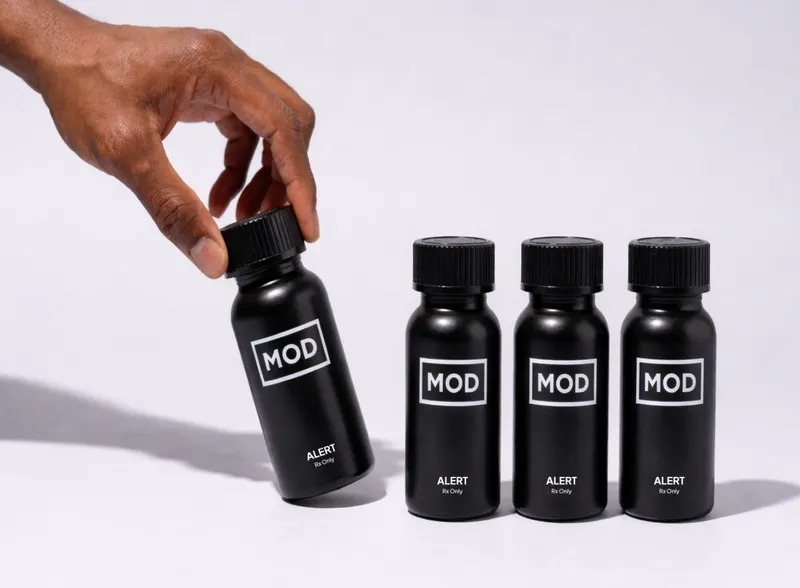
MOD Alert: Prescription-Strength Energy
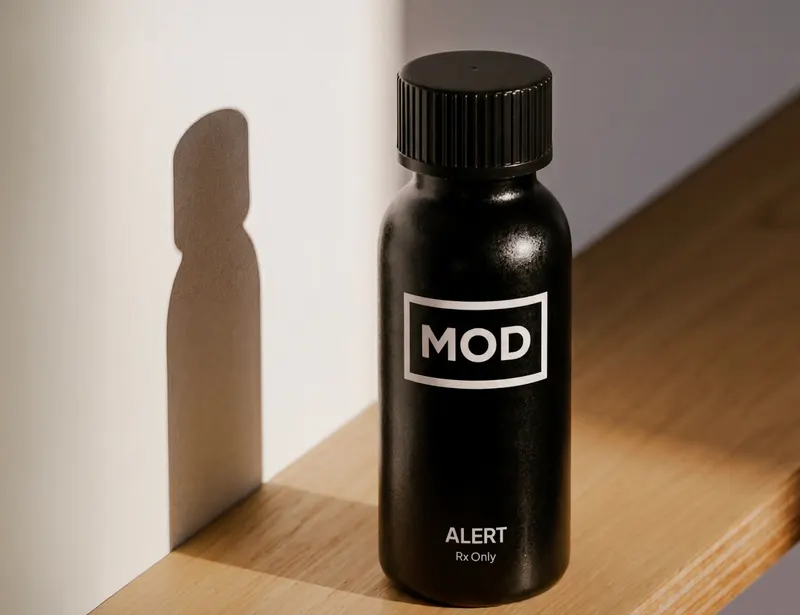
MOD Alert is a prescription-strength medication drink designed specifically for this problem, containing Modafinil 150 mg paired with 60 mg caffeine.
The formula is positioned as a lower-caffeine option than many coffees and energy drinks. The modafinil provides the sustained wakefulness for 12 to 15 hours, while the caffeine helps with the initial, familiar energy onset.
For shift workers and high-performers who can't afford a 4-hour energy window or the anxiety-fatigue cycle, MOD Alert may represent a meaningful alternative, one built around pharmacology rather than fighting against it.
MOD products are compounded medications and are NOT FDA-approved as products. You get them through a telehealth prescription process: complete an online intake, have your information reviewed by a licensed provider, and your order ships directly to your door, no waiting rooms.
Common Mistakes When Managing Caffeine Anxiety
Switching to more energy drinks. Energy drinks often contain more caffeine than people realize, 200 mg+ for some popular options, plus sugar that adds a second crash layer on top of the caffeine anxiety. Moving from coffee to energy drinks rarely reduces the problem.
Going cold turkey. Abrupt cessation causes withdrawal symptoms that can closely mimic anxiety, headaches, irritability, fatigue, difficulty concentrating. For people with high daily intake, tapering by 25 to 50 mg every few days produces better outcomes.
Assuming more caffeine will fix the jitters. Some people interpret the mid-caffeine anxiety spike as a "wearing off" feeling and add another dose, compounding the adenosine blockade and adrenaline response rather than resolving it.
Ignoring the genetic component. If you've been managing your dose carefully and still feel anxious, you're probably a slow caffeine metabolizer or have ADORA2A sensitivity. Trying to manage a genetic predisposition with willpower isn't a long-term strategy.
Treating caffeine anxiety as a character flaw. The DSM-5 recognizes caffeine-induced anxiety disorder as a formal diagnosis. If caffeine consistently causes significant anxiety in your daily life, that's a clinical finding, not a sign you "can't handle coffee."
When to Talk to a Doctor
It's important to talk to a healthcare provider about caffeine anxiety if:
- Anxiety symptoms persist for hours after caffeine consumption and are affecting your work or relationships
- You've reduced caffeine intake but anxiety symptoms haven't improved after 2 to 3 weeks
- You have a pre-existing anxiety disorder, caffeine significantly amplifies existing vulnerability
- You're a shift worker or have Shift Work Sleep Disorder and need a sustainable wakefulness solution
- You're considering prescription wakefulness agents and want to understand if they're appropriate for your situation
A provider can assess whether caffeine-induced anxiety disorder is contributing to your symptoms and whether alternatives like prescription modafinil make sense for your circumstances.
Final Verdict
Caffeine anxiety isn't a willpower problem, it's a pharmacology problem. And it doesn't have one universal fix.
Here's how to decide what actually applies to your situation:
- If you're over 400 mg/day and occasionally anxious, cutting dose and adding L-theanine (200 mg per 100 mg caffeine) is the simplest, best-evidenced first step.
- If you've tried cutting back and the anxiety persists regardless of dose, you're likely a genetic slow metabolizer or carry the ADORA2A sensitivity variant, reducing total intake and switching to lower-caffeine sources like green tea removes the root cause better than stacking supplements.
- If you're a shift worker, emergency responder, or anyone who needs 12+ hours of sustained wakefulness without looping through anxiety and crashes, prescription modafinil-based options like MOD Alert represent a structurally different approach, one built around your actual use case, not a standard-hours schedule.
- If anxiety persists even after eliminating caffeine, that's a separate clinical picture, talk to a healthcare provider before trying to self-manage with over-the-counter options or any wakefulness agent.
For anyone stuck in the caffeine-anxiety cycle who still needs to perform at work, MOD Alert is worth evaluating. It's not a standard energy drink, it's a prescription wakefulness option designed to support sustained alertness through different pathways than caffeine alone.
See if MOD is right for you, take the free online assessment →
Frequently Asked Questions
What are the symptoms of caffeine anxiety?
Caffeine anxiety symptoms include racing heart (tachycardia), muscle tension, restlessness, irritability, difficulty concentrating, and a general sense of worry or unease. At higher doses, symptoms may extend to trembling, shortness of breath, and elevated blood pressure. These symptoms typically appear within 15 to 60 minutes of caffeine consumption and resolve gradually as blood caffeine levels fall over 3 to 12 hours.
Does caffeine make anxiety worse?
Yes, caffeine amplifies anxiety symptoms, particularly for people who already have an anxiety disorder. Caffeine's adrenaline-stimulating effect directly overlaps with the physiological signature of anxiety: elevated heart rate, muscle tension, and hypervigilance. Even moderate doses can intensify existing anxiety, and doses above 400 mg/day significantly increase anxiety risk even in people without a pre-existing anxiety disorder, per a 2024 meta-analysis.
Can quitting caffeine reduce anxiety?
Yes, but not immediately. Eliminating caffeine typically reduces baseline anxiety within 1 to 2 weeks as adenosine receptor sensitivity normalizes. However, the first 1 to 9 days often involve withdrawal symptoms, headaches, fatigue, and irritability, that can temporarily mimic or worsen anxiety. Tapering gradually (reducing intake by 25 to 50 mg every few days) minimizes withdrawal-induced anxiety compared to quitting cold turkey.
Can caffeine cause panic attacks?
Yes, caffeine can trigger panic attacks in people with a history of panic disorder. In a review of more than 235 participants, more than 50% of those with a prior history of panic attacks experienced panic attacks following caffeine consumption, per PubMed research. Caffeine activates the same physiological fight-or-flight response that underlies panic attacks.
How much caffeine causes anxiety?
The dose-response relationship begins at any level of caffeine consumption, but anxiety risk spikes significantly at ≥400 mg/day. A 2024 Frontiers in Psychology meta-analysis found a standardized mean difference of ~2.86 for anxiety risk at high doses. Even low-dose caffeine carries some moderate anxiety risk depending on individual sensitivity.
How long does caffeine-induced anxiety last?
Caffeine anxiety typically lasts 3 to 5 hours in people with average metabolism, based on caffeine's ~5-hour half-life. In slow metabolizers or those with liver conditions, symptoms can persist up to 12 hours. If you consumed a high dose late in the day, effects may overlap with your sleep window.
How do I stop caffeine-induced anxiety in the moment?
Hydrate with water, move your body to burn off excess adrenaline, and wait, there's no rapid reversal for caffeine already in your system. L-theanine (200 mg) can blunt some of the ongoing anxiety response. Avoid adding more caffeine or stimulants. If symptoms are severe (racing heart, difficulty breathing), seek medical attention.
Why does caffeine make me more anxious than other people?
Likely genetics. CYP1A2 enzyme variants control how quickly you metabolize caffeine, slow metabolizers experience longer, stronger effects from the same dose. ADORA2A gene variants affect how sensitive your adenosine receptors are to caffeine's blockade. Both factors are inherited and aren't something you can change through habit.
Does L-theanine help with caffeine anxiety?
Yes, L-theanine is the most evidence-backed partial fix for caffeine anxiety. A double-blind PMC study found that 200 mg L-theanine + 100 mg caffeine improved cognitive performance more than either alone, while mitigating caffeine-induced anxiety and tachycardia. The typical effective ratio is 2:1 L-theanine to caffeine.
What can I drink instead of coffee that won't give me anxiety?
Options include: green tea (lower caffeine + natural L-theanine), herbal teas (caffeine-free), electrolyte drinks, or, for people who need sustained wakefulness for work, a prescription wakefulness option like MOD Alert, which uses Modafinil 150 mg + caffeine. Speak to a provider to determine what's appropriate for your situation.
Is caffeine-induced anxiety disorder a real diagnosis?
Yes. The DSM-5 formally recognizes caffeine-induced anxiety disorder as a distinct diagnosis, alongside caffeine intoxication, caffeine withdrawal, and caffeine-induced sleep disorder. If caffeine consistently causes clinically significant anxiety that affects your functioning, it qualifies as a medical finding, not a personal weakness.
This article is provided for informational purposes only and does not constitute medical advice. The information presented is not a substitute for professional medical advice, diagnosis, or treatment. Always consult your healthcare provider to discuss the risks, benefits, and appropriateness of any treatment.
MOD offers access to healthcare providers who may prescribe compounded medications for the treatment of excessive daytime sleepiness associated with shift work sleep disorder (SWSD), when clinically appropriate.
The featured products include compounded medications that have not been approved by the FDA. Compounded medications may be prescribed under federal law but are not the same as, nor are they generic versions of, any FDA-approved medication. The FDA does not review compounded medications for safety, effectiveness, or manufacturing quality of compounded products. A prescription will only be written if deemed appropriate after the digital consultation by the licensed medical provider. Individual results may vary.
MOD is not a compounding pharmacy but a telemedicine service that links patients to licensed medical providers.