How to Survive Night Shifts as a Flight Attendant
Surviving night shifts as a flight attendant comes down to four habits: protect an anchor sleep block, block sunrise light after duty, stop caffeine 5 to 6 hours before planned sleep, and treat layovers as recovery first. That routine works because cabin-crew fatigue is usually driven by circadian disruption, bright light after duty, and fragmented daytime sleep, not a lack of discipline.
Flight attendant fatigue is measurable, not just "part of the job." In the FAA's 2010 field study of cabin crew, flight attendants averaged 5.7 hours of sleep on workdays versus 6.3 hours on days off, woke about four times per sleep episode, and spent only 77% of each sleep opportunity actually asleep. The FAA's current rule provides 10 consecutive hours of minimum rest for many flight attendant schedules, but that window still includes deplaning, transport, meals, showering, and winding down. This guide shows how to turn that limited time into better recovery, better alertness, and a clearer plan for when it's important to talk to a provider about Shift Work Sleep Disorder (SWSD).
Key Takeaways
- Flight attendant fatigue usually comes from circadian disruption, early report times, hotel sleep, and time-zone changes stacking on top of each other.
- Your best defense is a repeatable home-base sleep anchor, even if the rest of your schedule changes every week.
- After a red-eye, sunrise light can wake your brain up before you ever reach the hotel or your front door.
- In-flight crew rest helps, though research shows it is still lighter and less efficient than hotel sleep.
- Reserve schedules are easier to survive when you plan around likely call windows instead of trying to improvise every day.
- It is usually smart to stop caffeine about 5 to 6 hours before planned sleep, not 5 to 6 hours before duty ends.
- If you cannot sleep when off duty or stay alert when working despite a tight routine, it's important to ask about SWSD.
Before You Start
A flight attendant may finish a red-eye at sunrise, sit in bright terminals, ride to a noisy hotel, and try to sleep in the middle of the local day. Before the next trip, make sure you have a sleep mask, ear plugs, curtain clips, one easy pre-sleep snack, and a hard caffeine cutoff.
If you already deal with heavy snoring, unsafe drives home, or extreme caffeine dependence, move faster toward a medical conversation and compare your pattern against a shift work sleep disorder symptoms checklist.
How to Survive Night Shifts as a Flight Attendant: Steps
Follow the same core system every trip, then adjust only the timing details for reserve, red-eyes, layovers, and recovery days.
1. Build one home-base sleep anchor
Most flight attendants do best with one anchor sleep window at home plus small adjustments for each trip pattern. The exact hours matter less than consistency. Protect one repeatable block first and use naps to support it, not replace it.
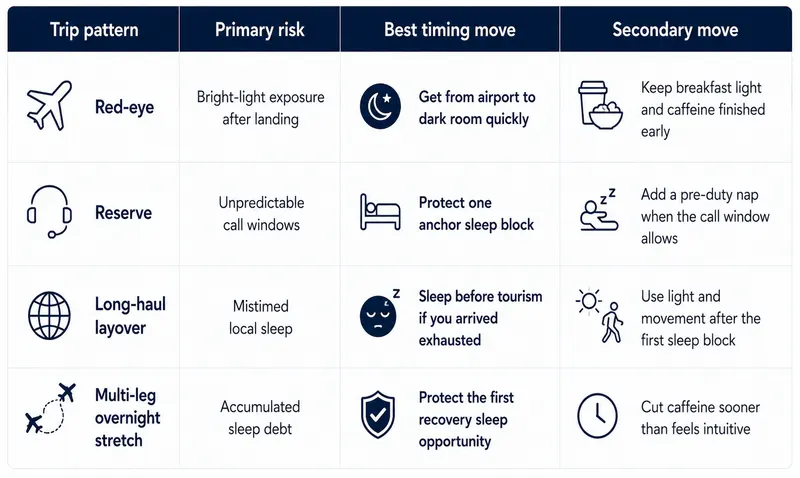
2. Split your plan by trip type
Stop using one generic plan for every sequence.
A recent layover-sleep study found that layover start timing strongly predicted how much crews slept and when that sleep happened.
3. Protect the commute after sunrise
Post-flight commutes are one of the most underrated parts of fatigue management. After an overnight segment, daylight, terminal activity, and conversation all tell your brain to stay awake.
Use a boring, repeatable post-duty routine:
- Put on dark sunglasses before you walk into daylight.
- Keep conversation and errands to a minimum.
- Eat something light only if you are actually hungry.
- Skip the "I will just rest for a minute" couch detour.
- Get the room cool, dark, and quiet fast.
4. Make the hotel room work for daytime sleep
Most flight attendants sleep in hotels on overnight layovers, and the room setup matters more than people think. CDC/NIOSH guidance for aircrew says the room should be quiet, dark, comfortable, and cool.
Treat the first 10 minutes in the room like part of your job:
- Clip the blackout curtains shut.
- Set the thermostat lower than feels fashionable.
- Silence the room phone if policy allows.
- Put your phone on do not disturb.
- Lay out your wake-up plan before you get into bed.
5. Treat crew rest as damage control, not recovery
Crew rest helps, though it should not fool you into thinking you are fully recovered. In a 2012 PMC-indexed sleep study of long-haul flight crew rest, sleep efficiency was about 70% in flight versus 88% in the layover hotel.
6. Use caffeine and food to protect the next sleep block
Base your caffeine plan on planned sleep time, not when the aircraft blocks in. NIOSH guidance for shift workers recommends avoiding caffeine at least 5 hours before bedtime.
Three rules work well for most flight attendants:
- Front-load caffeine into the first half of the duty period.
- Keep the pre-sleep meal light and easy to digest.
- Do not use alcohol as a layover sedative.
7. Plan naps instead of falling into them
Naps help most when they are scheduled around duty, not when they happen accidentally. A short 20- to 30-minute nap is useful when you need a reset without risking sleep inertia. A 90-minute nap is usually better before an overnight duty period.
For layovers, decide in advance which strategy you are using:
- Sleep first: best after overnight flying, sunrise arrivals, or obvious sleep debt
- Stay awake first: best when local time and your body clock are close enough that a short controlled stretch awake will improve nighttime sleep later
8. Know when fatigue has become a medical problem
Persistent insomnia off duty and excessive sleepiness on duty can point to Shift Work Sleep Disorder, not just "being bad at nights." Cleveland Clinic's overview of SWSD says the condition affects about 10% to 40% of people working nontraditional shifts.
If medication becomes part of the discussion, DailyMed says modafinil is FDA-approved to improve wakefulness in adults with excessive sleepiness associated with SWSD. MOD products themselves are compounded medications, so the finished products are not FDA-approved. It is also important to discuss potential side effects with your healthcare provider, including headache, nausea, anxiety, and insomnia.
How to Survive Night Shifts as a Flight Attendant: Tips
These habits make how to survive night shifts as a flight attendant feel repeatable instead of random.
- Keep one airport-to-bed routine after red-eyes.
- Pack the same layover sleep kit every trip instead of rebuilding it from memory.
- Decide before takeoff whether the layover is for recovery or sightseeing.
- Use movement and bright light early in the shift, not near planned sleep.
Common Mistakes to Avoid
Most failed night-shift plans break for the same four reasons.
- Treating legal rest like actual sleep: A legal rest window still includes transit, meals, showering, and winding down.
- Going sightseeing before first sleep on a rough layover: Recovery usually gets more expensive once you miss the best sleep window.
- Drinking caffeine too late because the shift is not over: Your sleep clock does not care when block-in happens.
- Assuming aircraft sleep is enough: Crew rest is useful, though it is not equivalent to hotel or home sleep.
- Normalizing unsafe fatigue: If driving home feels dangerous, that is a medical and operational problem, not just a rough trip.
How to Survive Night Shifts as a Flight Attendant Safely
Talk to your doctor when fatigue starts affecting sleep, alertness, driving safety, or mood instead of fading once the schedule normalizes.
That includes struggling to sleep in a dark quiet room, repeatedly fading during briefings or transport, depending on extreme caffeine to stay functional, or feeling your mood and memory slip even on recovery days.
If you suspect SWSD, sleep apnea, or another sleep disorder, consult your healthcare provider. If your provider thinks a wakefulness-promoting medication makes sense, MOD offers a shift-worker-focused telehealth prescription process with provider review and shipping if prescribed.
You can also review MOD plans, read the MOD FAQ, or contact MOD with support questions.
Where MOD May Fit for Flight Attendants With SWSD
For flight attendants, the first step is still tightening the basics: sleep timing, light control, caffeine timing, hotel-room setup, and safe post-duty transportation. If those habits are not enough and a provider agrees that SWSD may be part of the problem, MOD may be relevant as a shift-worker-focused option.
MOD Alert is designed for shift-work wakefulness and combines 150 mg modafinil with 60 mg caffeine. It should be discussed as a compounded prescription medication for qualifying patients, not as a general fatigue fix or a replacement for sleep.

Frequently Asked Questions
What are FAA rest requirements for attendants?
Most attendants now get 10 consecutive hours of minimum rest for many schedules under the FAA's current rule. In real life, that legal rest still includes transport, meals, showering, and winding down, so it does not guarantee 10 hours of actual sleep. That is why a repeatable airport-to-bed routine matters after red-eyes.
Where do flight attendants sleep on long-haul flights?
On long-haul flights, attendants usually sleep in designated crew-rest bunks or rest seats during scheduled breaks. That sleep helps reduce fatigue, but it should be treated as damage control rather than full recovery. Hotel or home sleep is usually a better opportunity for deeper, more efficient rest.
How do flight attendants deal with time zones and jet lag?
Flight attendants manage time zones best by protecting one anchor sleep window, using light deliberately, and choosing a sleep-first or stay-awake-first layover plan. The goal is not to feel perfectly adapted everywhere. The goal is to stay functional, protect recovery sleep, and avoid stacking sleep debt across several trips.
What sleep schedule works for red-eyes?
A good red-eye sleep schedule starts with one repeatable home-base anchor, then adds a fast post-duty sleep block after sunrise arrivals. Most flight attendants do better when they wear dark glasses after landing, get to a cool dark room quickly, and avoid letting errands drift into their best daytime sleep window.
Can flight attendants get shift work sleep disorder?
Yes. Flight attendants can develop SWSD when irregular schedules, overnight duty, early reports, or rotating time zones repeatedly interfere with sleep and alertness. If insomnia happens off duty, excessive sleepiness shows up on duty, and the pattern continues despite better sleep timing, light control, and caffeine habits, it’s important to talk to a healthcare provider.
This article is provided for informational purposes only and does not constitute medical advice. The information presented is not a substitute for professional medical advice, diagnosis, or treatment. Always consult your healthcare provider to discuss the risks, benefits, and appropriateness of any treatment.
MOD offers access to healthcare providers who may prescribe compounded medications for the treatment of excessive daytime sleepiness associated with shift work sleep disorder (SWSD), when clinically appropriate.
The featured products include compounded medications that have not been approved by the FDA. Compounded medications may be prescribed under federal law but are not the same as, nor are they generic versions of, any FDA-approved medication. The FDA does not review compounded medications for safety, effectiveness, or manufacturing quality of compounded products. A prescription will only be written if deemed appropriate after the digital consultation by the licensed medical provider. Individual results may vary.