Modafinil vs Ritalin in 2026: Key Differences and Best Uses
Modafinil vs Ritalin is usually a choice between sustained wakefulness and shorter-window ADHD-focused stimulant support. Modafinil is usually the better medication for long overnight coverage and Shift Work Sleep Disorder (SWSD), while Ritalin is usually the better medication for diagnosed ADHD and faster-onset focus support.
That first split matters more than internet hype. Modafinil is approved to improve wakefulness in adults with narcolepsy, obstructive sleep apnea, and Shift Work Sleep Disorder, while Ritalin is a methylphenidate medication used for ADHD and narcolepsy. If your real problem is shift-work fatigue, brain fog on overnight shifts, or a schedule that keeps fighting your sleep timing, modafinil usually has the cleaner argument. If your real problem is classic ADHD symptom control, Ritalin usually does.
Key Takeaways
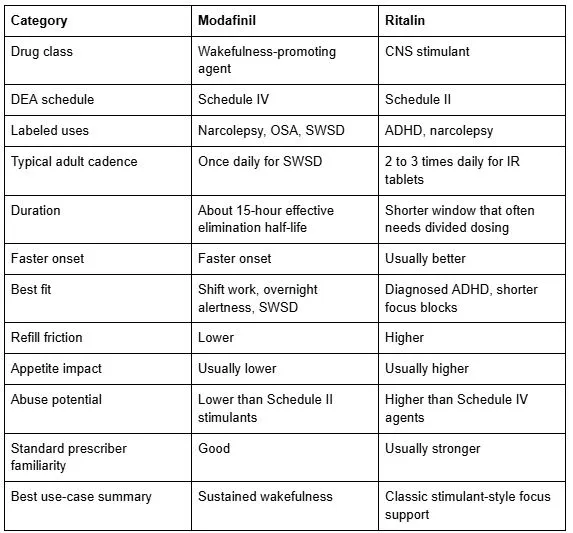
- Modafinil usually wins for long wakefulness coverage because the label supports once-daily SWSD dosing and lists an effective elimination half-life of about 15 hours.
- Ritalin usually wins for diagnosed ADHD because methylphenidate is directly labeled for ADHD and is easier to adjust in shorter focus windows.
- Modafinil usually has less controlled-substance friction because it is listed as Schedule IV, while Ritalin tablets are Schedule II.
- Ritalin can win on faster onset and mainstream ADHD workflow because it is familiar across psychiatry and primary care.
- Ritalin may raise more appetite and comedown concerns because methylphenidate stimulant treatment is commonly associated with appetite suppression, insomnia, and end-of-dose wear-off concerns.
- MOD only makes sense when your provider agrees the wakefulness lane is the right lane because MOD is purpose-built around shift-worker fatigue, not standard ADHD stimulant care.
Quick Overview
Modafinil
Modafinil is a wakefulness-promoting agent used to improve wakefulness in adults with narcolepsy, obstructive sleep apnea, and Shift Work Sleep Disorder. It is usually discussed when the goal is staying alert across a long shift, reducing overnight brain fog, or supporting a schedule that fights normal circadian rhythm. DailyMed lists modafinil as Schedule IV with once-daily SWSD dosing and an effective elimination half-life of about 15 hours.
Ritalin
Ritalin is a methylphenidate stimulant used for ADHD and narcolepsy. It is usually the better fit when the main goal is shorter-window focus support, task initiation, and standard ADHD treatment pathways. DailyMed lists Ritalin tablets as Schedule II, and immediate-release dosing is commonly divided 2 or 3 times daily.
Feature-by-Feature Comparison
Pricing & Access Comparison
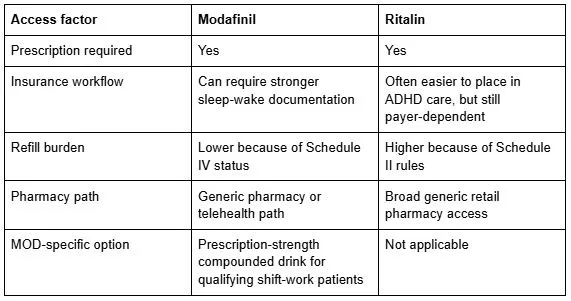
There is no single clean winner on sticker price because the real cost depends on insurance, pharmacy access, follow-up requirements, and diagnosis. Ritalin usually has the easier generic-pharmacy path. Modafinil can still be accessible, but the real friction is often whether the diagnosis clearly supports a wakefulness treatment lane.
Pros & Cons
Modafinil Pros
- Strongest labeled fit for Shift Work Sleep Disorder.
- Better match for sustained wakefulness than short bursts of stimulant force.
- Lower schedule burden than Ritalin because it is Schedule IV.
- Often easier to live with when all-day coverage matters more than fast onset.
Modafinil Cons
- Not the best first-line medication when diagnosed ADHD is the main issue.
- Potential side effects can include headache, nausea, anxiety, insomnia, and rare but serious rash warnings.
- Access may depend on better sleep-wake documentation.
- MOD products are compounded medications and are not FDA-approved as products.
Ritalin Pros
- Stronger fit for classic ADHD treatment.
- Faster, shorter-window effect can be useful when you do not want all-day coverage.
- Familiar across mainstream ADHD care.
- Usually easier to find through standard generic pharmacy channels.
Ritalin Cons
- Schedule II status creates tighter refill timing and more prescribing friction.
- Appetite suppression, insomnia, palpitations, and end-of-dose wear-off concerns can be harder day to day.
- Less natural fit for SWSD.
- Higher abuse-potential conversation than modafinil.
Side Effects Comparison
It is important to compare these as different risk profiles, not as "safe" versus "dangerous." Schedule II stimulants such as Ritalin usually come with higher addiction-risk scrutiny and more cardiovascular monitoring concerns, while modafinil is Schedule IV with lower abuse potential. That does not mean side effects should be minimized for either option.
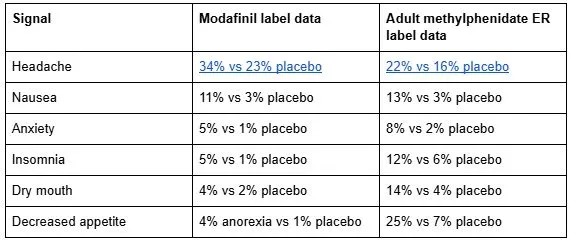
This table uses adult methylphenidate ER label data for context, not Ritalin immediate-release tablet-specific rates. Drug interactions matter too. Modafinil can affect hormonal contraceptive effectiveness, and both medications deserve a real review of sleep, blood pressure, anxiety history, and other medications. Consult your healthcare provider to determine which option is right for you.
Why MOD May Fit Shift-Work Wakefulness Better
For shift workers, the main question is not whether modafinil or Ritalin is stronger. It is which treatment lane matches the real problem. Ritalin is a conventional ADHD and narcolepsy medication, while MOD is focused on prescription-strength wakefulness support for qualifying patients with shift-work-related sleepiness.
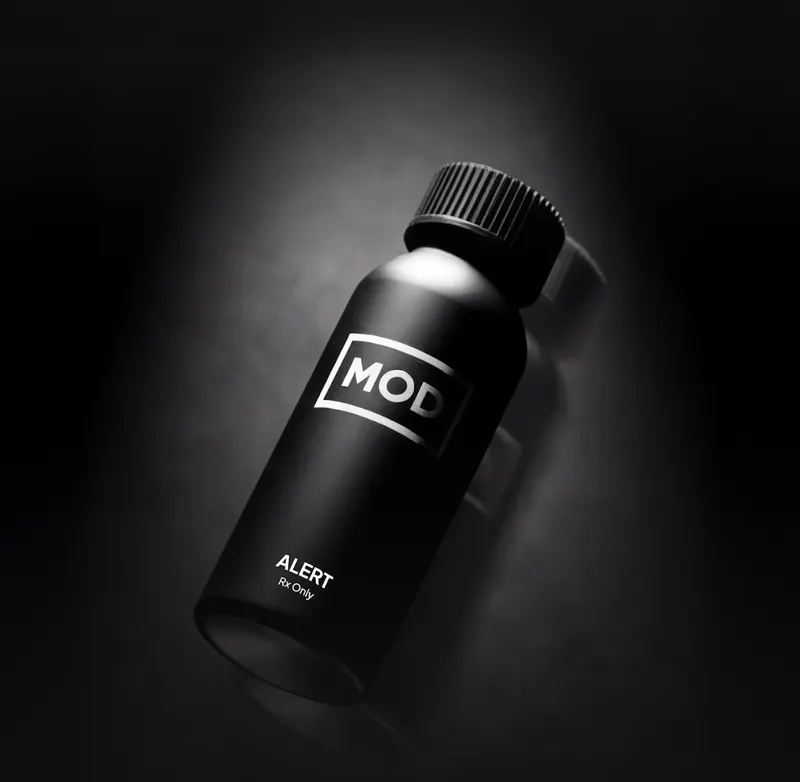
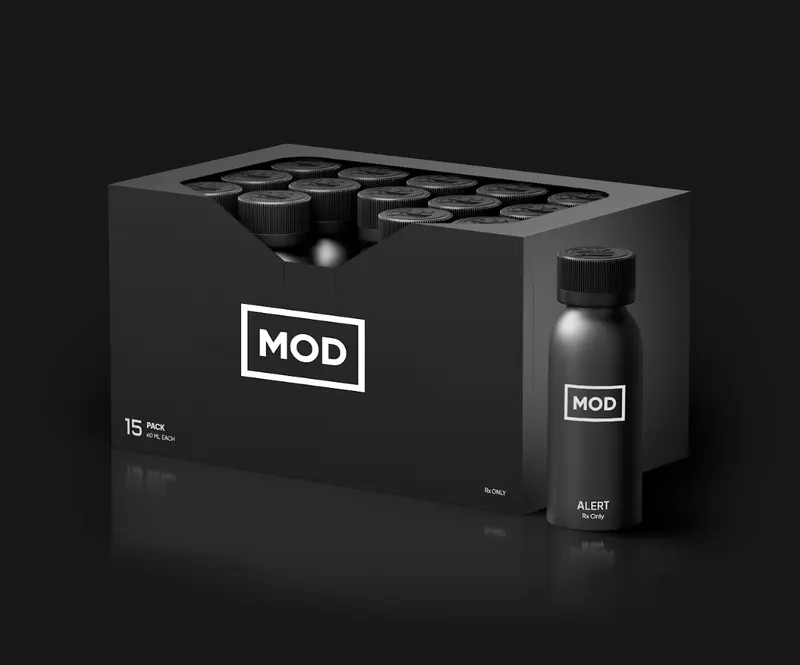
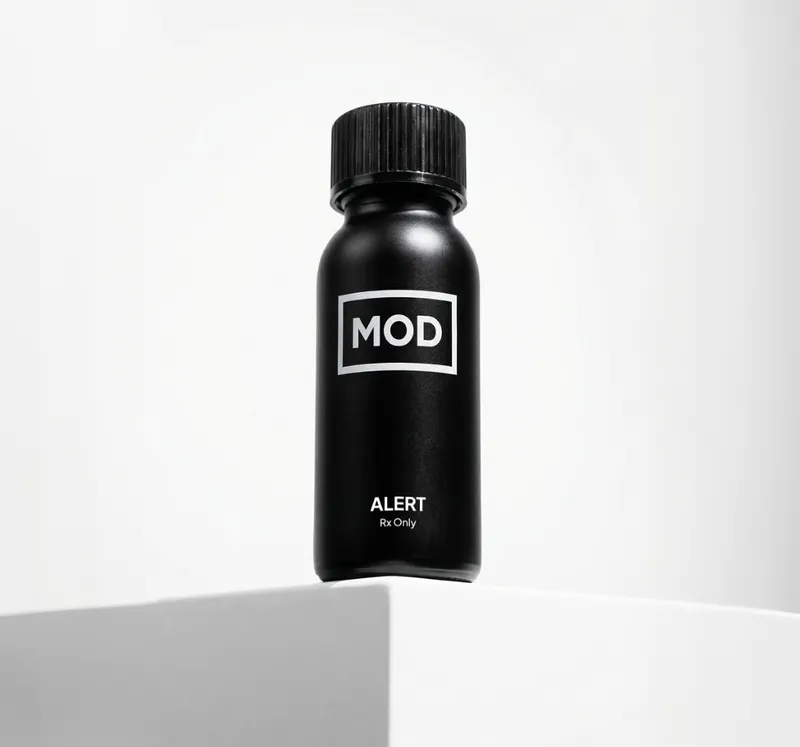
If your primary need is staying awake and functional during overnight or rotating shifts, MOD Alert is the more relevant MOD option to discuss. MOD Alert combines 150 mg modafinil with caffeine for wakefulness support and is designed as a compounded prescription-strength drink for qualifying patients, not an off-the-shelf energy product. If your symptoms are more about diagnosed ADHD, task initiation, or daytime attention control, a standard ADHD workflow with a clinician may make more sense.
Learn more about MOD plans.
Frequently Asked Questions
Is modafinil better than Ritalin for shift work?
Usually, yes, when the real issue is excessive sleepiness or Shift Work Sleep Disorder. Modafinil is approved to improve wakefulness in adults with SWSD, while Ritalin is better aligned with ADHD care. The better option still depends on your diagnosis, schedule, medical history, and how your provider weighs the risks and benefits.
Is Ritalin better than modafinil for ADHD?
Usually, yes. Ritalin is directly labeled for ADHD and fits standard stimulant treatment pathways better than modafinil. Modafinil may come up in some off-label conversations, but it is not the usual first-line ADHD medication. If ADHD is the main concern, it is important to work within a clinician-guided ADHD treatment plan.
Which lasts longer?
Modafinil usually lasts longer. DailyMed lists an effective elimination half-life of about 15 hours for modafinil, while Ritalin immediate-release dosing is commonly divided 2 or 3 times daily. That longer window can help shift-work wakefulness, but it can also interfere with sleep if timing is not managed carefully.
Which has lower abuse potential?
Modafinil usually does because it is Schedule IV, while Ritalin is Schedule II. That does not remove risk, but it does change the misuse and refill conversation. Both medications should be taken only as prescribed and reviewed with a licensed healthcare provider, especially if there is a history of substance misuse.
What side effects differ most?
Potential side effects differ by medication. Ritalin more often raises appetite suppression, insomnia, palpitations, and end-of-dose wear-off concerns. Modafinil more often raises headache, nausea, anxiety, and insomnia concerns. Serious reactions are less common, but any rash, chest pain, severe anxiety, or troubling symptom should be discussed with a clinician promptly.
This article is provided for informational purposes only and does not constitute medical advice. The information presented is not a substitute for professional medical advice, diagnosis, or treatment. Always consult your healthcare provider to discuss the risks, benefits, and appropriateness of any treatment.
MOD offers access to healthcare providers who may prescribe compounded medications for the treatment of excessive daytime sleepiness associated with shift work sleep disorder (SWSD), when clinically appropriate.
The featured products include compounded medications that have not been approved by the FDA. Compounded medications may be prescribed under federal law but are not the same as, nor are they generic versions of, any FDA-approved medication. The FDA does not review compounded medications for safety, effectiveness, or manufacturing quality of compounded products. A prescription will only be written if deemed appropriate after the digital consultation by the licensed medical provider. Individual results may vary.
MOD is not a compounding pharmacy but a telemedicine service that links patients to licensed medical providers.