Why Modafinil Is Popular Among High Performers

From Silicon Valley boardrooms to hospital call rooms, one prescription medication keeps coming up in conversations about staying sharp under pressure: Modafinil.
It's not a stimulant in the traditional sense, and it isn't approved by the FDA as a "performance" drug. But among founders, surgeons, traders, and shift workers who can't afford a foggy brain, Modafinil has developed a reputation as the wakefulness aid of choice — and the research on why is more substantial than most people realize.
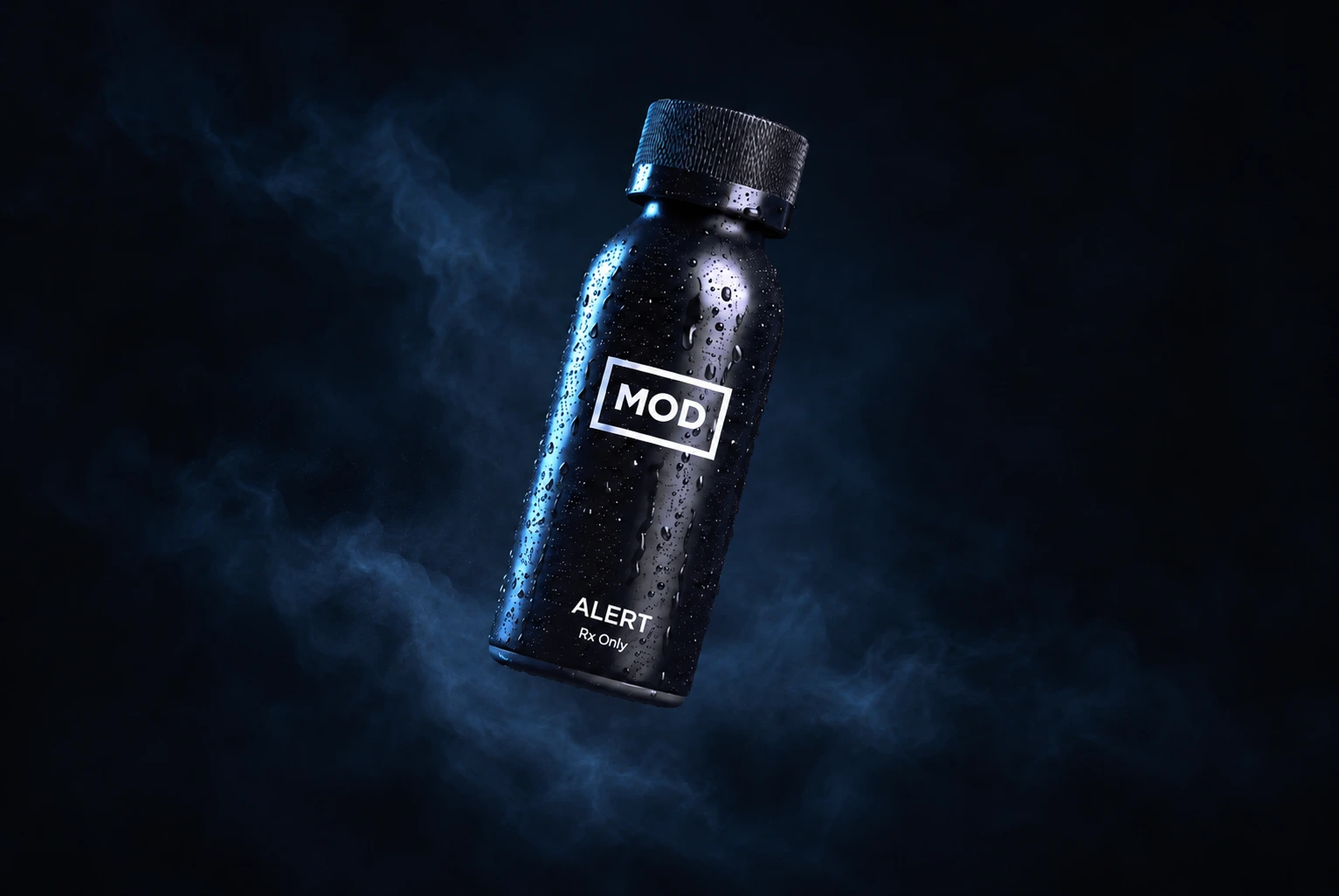
Below, we'll break down what's actually driving Modafinil's popularity among high performers, what the peer-reviewed literature says about its cognitive effects, and how to access MOD Alert, a prescription-strength compounded drink containing the active ingredient Modafinil, through MOD.com.
Key Takeaways
- Modafinil is FDA-approved for excessive daytime sleepiness linked to shift work sleep disorder, narcolepsy, and obstructive sleep apnea — but a large share of its real-world use is off-label, driven by professionals seeking sustained focus.
- A systematic review of 24 studies found Modafinil improves attention, executive function, and learning in non-sleep-deprived, healthy adults — not just people who are exhausted.
- Surveys of scientists, surgeons, and students report meaningful rates of off-label cognitive-enhancer use, with Modafinil consistently named among the most common substances.
- Unlike classic stimulants, Modafinil produces a steadier alertness curve with a lower reported potential for dependence, which may explain its appeal to people optimizing for consistency over intensity.
- MOD Alert offers a legitimate, telehealth-based path to a Modafinil prescription for those who qualify, rather than sourcing the medication without medical oversight.

What "High Performer" Use Actually Looks Like
Modafinil's FDA-approved indications are narrow: shift work sleep disorder, narcolepsy, and obstructive sleep apnea. But anecdotally, and increasingly in the data, its use extends well past that list.
One widely cited online survey of 219 self-reported Modafinil users found the typical profile was male, university-educated, currently employed, and in his late twenties — not a narcoleptic patient, but someone using the medication to work, study, or compete more effectively. Respondents generally rated Modafinil as safe, and heavier use was associated with a higher number of perceived benefits.
That pattern shows up across professions. A 2013 survey of surgeons found that nearly one in five had used a cognitive enhancer at least once, and a 2014 survey of British and Irish university students put current use of prescription cognitive enhancers at over 3%. Perhaps the most-cited data point comes from a 2008 informal poll of 1,400 Nature readers across 60 countries, in which one in five respondents said they'd used cognitive-enhancing drugs — Modafinil among the three named — to sharpen focus or memory.
None of this means Modafinil is approved or intended for this kind of use. It means a lot of high performers have decided, often without medical guidance, that it's worth trying.
What the Research Actually Shows About Cognitive Performance
The more interesting question isn't whether people are using Modafinil this way — it's whether it works when someone isn't already sleep-deprived.
For years, the honest answer was "unclear." Early studies were mixed, and much of the initial enthusiasm outpaced the evidence. That started to change with a 2015 systematic review and meta-analysis from researchers at Oxford and Harvard Medical School, who evaluated every study on Modafinil and cognition in non-sleep-deprived adults published between 1990 and 2014. Across 24 qualifying studies, they found that Modafinil reliably improved performance on tasks involving executive function — planning, decision-making, and inhibitory control — with more mixed effects on simple attention and memory tasks.
Other controlled studies back this up in more specific ways:
- A 2010 randomized, placebo-controlled study found that even well-rested, non-sleep-deprived participants showed improved attention, working memory, and decision-making speed after taking Modafinil, without the anxiety or overstimulation often reported with traditional stimulants.
- Research on emergency physicians working overnight found Modafinil helped restore focus and alertness that had degraded from the shift itself — directly relevant to the high-stakes, high-fatigue jobs where interest in the drug tends to concentrate.
- A 2003 study using simulated night-shift conditions found Modafinil reversed sleep-deprivation-related declines in cognitive performance and mood, suggesting the benefit isn't purely about staying awake — it's about staying capable while awake.
Taken together, the literature supports a specific, more modest claim than "smart pill" headlines usually make: Modafinil appears to meaningfully support attention and executive function, particularly under conditions of fatigue, with real but smaller effects in people who are already well-rested.
Why Modafinil, Specifically — Not Just Any Stimulant
High performers have no shortage of options: caffeine, Adderall, Ritalin. So why has Modafinil become the one people quietly mention on podcasts and LinkedIn bios?
A flatter, longer curve. Classic stimulants tend to produce a sharper peak and a harder crash. Modafinil's effects build over roughly 2 to 4 hours to reach peak concentration but begin within an hour, and the resulting alertness tends to be described as steadier and more sustained — a better match for a 10-hour trading day or a double shift than for a quick jolt.
Fewer of the classic stimulant side effects. Research in narcolepsy patients has found that Modafinil, unlike amphetamine-type stimulants, doesn't produce a clinically significant increase in heart rate or blood pressure at approved doses — a meaningful consideration for anyone concerned about cardiovascular strain from long-term use.
Lower reported abuse potential. Modafinil doesn't appear to produce the same euphoric highs associated with amphetamine-class stimulants, which is part of why researchers have studied it as a potential treatment for cocaine and methamphetamine dependence rather than a substance that drives it. That distinction matters to people who want a focus aid without taking on dependence risk.
It's legitimately prescribable. Unlike unregulated "nootropic stacks," Modafinil has an established FDA-approved use for shift work sleep disorder, meaning there's a legal, medically supervised path to a prescription for people who qualify — rather than sourcing it from unregulated sources.
The Limits Worth Knowing About
None of this makes Modafinil risk-free or universally effective, and it's worth being direct about that.
The 2015 Oxford/Harvard review noted that Modafinil's benefits were strongest for demanding, effortful tasks and weaker or inconsistent for simpler ones — it isn't a blanket upgrade to every kind of thinking.
Some research has also found it can modestly impair divergent creative thinking even as it improves focus, suggesting a trade-off between narrow concentration and open-ended idea generation. And a 2024 study comparing off-prescription Modafinil and methylphenidate users to non-users found that users reported higher, not lower, baseline levels of inattention and procrastination — a reminder that self-selected "high performer" use often starts from a specific, personal motivation rather than a desire for a generic edge.
Modafinil also isn't appropriate for everyone. It carries interaction risks with hormonal birth control and certain other medications, and it isn't recommended for people with a history of certain cardiac or psychiatric conditions without medical guidance.
Getting Modafinil the Right Way
Interest in Modafinil doesn't have to mean sourcing it without oversight. If you have shift work sleep disorder or another qualifying condition, a licensed medical provider can evaluate whether it's an appropriate option for you.
MOD.com offers MOD Alert, a prescription-strength compounded drink containing the active ingredient Modafinil, through a straightforward telehealth process:
- Choose your plan at MOD.com.
- Complete an online medical intake form and a short tele-visit.
- A licensed medical provider reviews your information, typically within 24 hours.
- If approved, your prescription ships directly to your door.
Plans start at $98/month, with the flexibility to modify or cancel anytime.
FAQs
Is it legal to take Modafinil if I don't have narcolepsy?
Yes. Modafinil is FDA-approved for the treatment of shift work sleep disorder.
Does Modafinil actually make you smarter?
No credible research supports that framing. The evidence points to real but specific improvements in attention and executive function, particularly under fatigue, rather than a general intelligence boost.
Why do so many executives and surgeons report using it?
High-stakes, high-fatigue professions place a premium on sustained focus over long hours, which lines up with what the research shows Modafinil is best at. Reported use in these groups is common, but off-label and not a formal recommendation.
Is Modafinil addictive?
Research suggests it carries a lower dependence risk than amphetamine-type stimulants and doesn't produce the same euphoric effects, which is part of why it's been studied as a potential treatment for stimulant addiction. It should still only be used under medical guidance.
Related Articles

Feel like yourself again
- Prescription modafinil
- Built for night shift
- Licensed provider review
*Prescription products require an online review by a licensed provider. Restrictions apply.

Medically reviewed
Every article is reviewed by a licensed provider on the MOD medical team.