Why Is Modafinil Better Than Adderall or Ritalin?
When people start researching ways to improve focus, energy, and productivity, medications like Adderall, Ritalin, and Modafinil often come up.
Adderall and Ritalin are widely used stimulant medications that treat attention deficit hyperactivity disorder (ADHD). While they can be effective for improving concentration, they work by strongly stimulating the central nervous system.
Modafinil works differently.
Rather than directly stimulating the brain like amphetamines, Modafinil promotes wakefulness by influencing multiple neurotransmitters involved in alertness, attention, and cognitive performance. Because of this unique mechanism, many people find that Modafinil provides long-lasting focus with fewer side effects and less risk of dependence compared with traditional stimulants.
Below, we’ll break down how Modafinil compares with Adderall and Ritalin—and why it’s becoming a popular option for sustained mental performance.
Key Takeaways
- Modafinil is a wakefulness-promoting medication that works differently from stimulant drugs like Adderall and Ritalin.
- Unlike amphetamines, Modafinil influences several brain chemicals involved in alertness and cognition.
- Research suggests Modafinil may produce long-lasting focus with fewer cardiovascular side effects than traditional stimulants.
- Modafinil has a lower risk of abuse and dependence and is classified as a Schedule IV controlled substance.
- Many users report steady energy and concentration without the jitteriness or crash associated with stimulant medications.

Modafinil vs Adderall vs Ritalin: What’s the Difference?
Adderall and Ritalin are both classified as central nervous system stimulants used to treat ADHD. These medications increase dopamine and norepinephrine activity in the brain, which helps improve attention and reduce hyperactivity.
Adderall contains amphetamine salts, while Ritalin contains methylphenidate. Both drugs stimulate the brain’s reward pathways and nervous system.
Instead of strongly activating dopamine reward circuits, Modafinil influences multiple neurotransmitter systems involved in the sleep-wake cycle—including dopamine, serotonin, norepinephrine, histamine, glutamate, and orexin. This broader mechanism helps promote alertness and cognitive performance in a more balanced way.
Research exploring the mechanisms of modafinil suggests that its effects come from reducing dopamine transporter activity and enhancing wakefulness pathways in the brain.
Smoother Energy Without the “Amphetamine Crash”
One of the most common complaints about stimulant medications like Adderall or Ritalin is the energy crash that can occur when the drug wears off.
Because these medications strongly stimulate dopamine systems, they can produce a rapid spike in energy followed by fatigue, irritability, or difficulty concentrating.
Modafinil tends to work more gradually.
Studies examining wakefulness-promoting medications show that Modafinil can provide sustained alertness for up to 12–15 hours, helping individuals remain focused throughout the day without the sharp peaks and crashes often associated with amphetamines.
Lower Risk of Dependence
Another major difference between Modafinil and traditional stimulant medications is addiction potential.
Adderall and Ritalin are classified as Schedule II controlled substances, meaning they carry a higher risk of abuse and dependence.
Modafinil is classified as a Schedule IV controlled substance, indicating a significantly lower risk of misuse.
Researchers believe this difference is due to Modafinil’s weaker interaction with dopamine transporters, which prevents the intense dopamine spikes responsible for euphoria and addiction seen with amphetamines.
Interestingly, some studies have even explored Modafinil as a potential treatment for stimulant dependence, including cocaine addiction.
Fewer Cardiovascular Side Effects
Traditional stimulant medications often activate the body’s sympathetic nervous system, which can increase heart rate and blood pressure.
Because of this, people taking Adderall or Ritalin may experience side effects such as:
- jitteriness
- anxiety
- increased heart rate
- elevated blood pressure
Modafinil appears to have less impact on the cardiovascular system because it primarily promotes wakefulness through brain pathways involved in alertness rather than strong autonomic stimulation.
This difference may explain why many users report a smoother and more stable energy experience.
Longer-Lasting Focus
Another advantage of Modafinil is its long duration of action.
While many stimulant medications last 4–8 hours, Modafinil’s wakefulness-promoting effects often last 12–15 hours.
This longer duration is one reason Modafinil is commonly used to treat conditions like:
- narcolepsy
- shift work sleep disorder
- excessive daytime sleepiness
These conditions require consistent alertness throughout the day, not just short bursts of stimulation.
Modafinil vs Adderall vs Ritalin: Quick Comparison
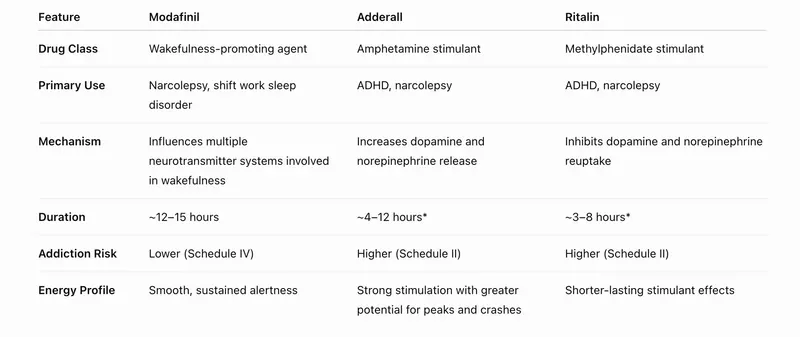
Research suggests Modafinil promotes wakefulness through several brain pathways rather than strongly stimulating dopamine reward circuits like amphetamines do.Who Might Choose Modafinil Instead of Adderall?
While stimulant medications are highly effective for ADHD treatment, some individuals may prefer Modafinil because of its different mechanism and smoother energy profile.
Modafinil may be a better option for people who:
- Need long-lasting focus for extended workdays or night shifts
- Experience jitters or anxiety from traditional stimulants
- Want sustained mental performance without an energy crash
- Prefer medications with a lower risk of dependence
- Struggle with fatigue, excessive daytime sleepiness, or shift work sleep disorder
Because Modafinil works through several wakefulness pathways rather than strong stimulant effects, it can provide steady cognitive support without the intense highs and lows of amphetamines.
Final Thoughts
Adderall and Ritalin remain important medications for treating ADHD, but they aren’t the only options for improving focus and wakefulness. Modafinil offers a different approach—supporting alertness through multiple brain pathways instead of strong stimulant effects.
Because of its long-lasting energy, smoother cognitive support, and lower risk of dependence, Modafinil has become an increasingly popular option for professionals, students, and shift workers who need reliable mental performance throughout the day.
Explore MOD Alert
Long shifts, demanding schedules, and busy lives require reliable support.
MOD makes it easy to get prescription wakefulness support completely online.
Complete a medical intake, connect with a licensed healthcare provider, and find out whether MOD Alert may be appropriate for you.
No waiting rooms. No pharmacy lines. Just convenient, modern care designed for busy adults.
FAQs
Is Modafinil stronger than Adderall?
Not necessarily stronger—just different. Adderall strongly stimulates dopamine pathways, while Modafinil works through several wakefulness-related neurotransmitters to produce more gradual and sustained alertness.
Why do some people prefer Modafinil to Adderall?
Many users report that Modafinil provides steadier focus, fewer jitters, and less of a crash compared with traditional stimulant medications.
Is Modafinil addictive?
Modafinil has a lower risk of addiction than amphetamine stimulants and is classified as a Schedule IV controlled substance.
How long does Modafinil last?
Modafinil typically lasts 12–15 hours, making it ideal for promoting wakefulness throughout long workdays or shift schedules.
Can Modafinil be used for ADHD?
Modafinil is not FDA-approved for ADHD but has been studied as a potential alternative for improving attention and cognitive performance.
This article is provided for informational purposes only and does not constitute medical advice. The information presented is not a substitute for professional medical advice, diagnosis, or treatment. Always consult your healthcare provider to discuss the risks, benefits, and appropriateness of any treatment.
MOD offers access to healthcare providers who may prescribe compounded medications for the treatment of excessive daytime sleepiness associated with shift work sleep disorder (SWSD), when clinically appropriate.
The featured products include compounded medications that have not been approved by the FDA. Compounded medications may be prescribed under federal law but are not the same as, nor are they generic versions of, any FDA-approved medication. The FDA does not review compounded medications for safety, effectiveness, or manufacturing quality of compounded products. A prescription will only be written if deemed appropriate after the digital consultation by the licensed medical provider. Individual results may vary.
MOD is not a compounding pharmacy but a telemedicine service that links patients to licensed medical providers.