How to Survive Night Shifts as an Oil Rig Worker in 2026
By the time a night shift ends offshore, the job is not really over. The rig is still loud, daylight is coming up, someone else’s alarm is going off, and your body may feel too keyed up to sleep even though your brain is running on fumes. Then the next night starts before you have fully recovered.
That is not just part of being tough enough for the job. In a 2009 North Sea study, close to 80% of offshore oil rig workers reported some to very much sleep problems related to offshore work, and 35% reported insufficient sleep during the work period, according to PMC. OSHA also says older research found accident and injury rates were 30% greater on night shifts than on day shifts.
The practical answer is to make your off-shift recovery less random: lock in one post-shift sleep block, set your caffeine cutoff before the shift starts, use light and movement before the 2 a.m. to 5 a.m. dip, and take repeated excessive sleepiness seriously. This guide helps you build that system around real rig conditions: shared quarters, crew-change noise, 12-hour shifts, swing rotations, post-shift travel risk, and the point where ongoing fatigue may be worth discussing with a clinician.
Key Takeaways
- Surviving offshore nights usually means defending one repeatable post-shift sleep block instead of trying to sleep whenever you can.
- In a 2009 North Sea study, close to 80% of oil rig workers reported some to very much sleep problems related to offshore work, and 35% reported insufficient sleep during the work period, according to PMC.
- OSHA says older research found accident and injury rates were 30% greater on night shifts than on day shifts, so oil rig fatigue is a safety issue, not just a comfort issue.
- Offshore workers often adapt to night work during the hitch and then struggle more when they flip back home, according to a systematic review on PubMed Central.
- If better sleep timing, smarter caffeine use, and a tighter bunk routine still are not enough, it is important to ask whether SWSD is part of the problem.
Before You Start: The Four Rules That Matter Most
Build the System Before the Slump
Surviving offshore nights comes down to four repeatable steps: protect sleep, stop caffeine early, use countermeasures before the slump, and escalate persistent sleepiness.
- Protect one post-shift sleep block so your recovery window stays predictable.
- Set a caffeine cutoff early in the shift so you are not wide awake in the bunk.
- Use light, movement, and short naps before the slump instead of waiting until you are fading.
- Escalate persistent excessive sleepiness because repeated near-misses and unsafe commutes are not routine fatigue.
Why Surviving Night Shifts Offshore Is Harder
Offshore Fatigue Stacks Up Fast
Offshore night shifts hit harder because they combine circadian disruption, long shifts, shared living space, compressed hitches, and a worksite that never quiets. In one 2009 offshore oil-rig sample, close to 80% of workers reported some to very much sleep problems related to offshore work, and 35% reported insufficient sleep during the work period.
Night Work Is a Safety Issue
OSHA reports that older research found accident and injury rates were 18% greater on evening shifts and 30% greater on night shifts than on day shifts. An older PubMed study on Norwegian oil rig workers found sleep quality worsened by the end of a two-week offshore work period.
Step 1: Build a Night-Shift Sleep Schedule
Use One Main Sleep Block
A workable oil rig sleep schedule uses one anchor block after shift and one optional pre-shift nap instead of broken sleep.
For a 6 p.m. to 6 a.m. or 7 p.m. to 7 a.m. pattern, most workers do best when they go to sleep as soon as possible after handoff, hygiene, and a light meal. The biggest mistake is stretching that window with conversation, screens, or extra daylight.
Plan Around Swing Rotations
In a 2016 NIOSH summary, prolonged sleep-onset latency was reported more often in night-shift and rotating-shift workers than in daytime workers. For swing schedules such as 7N/7D, it helps to plan for both halves of the hitch before you arrive. The offshore review cited above found adaptation to night work was generally complete within one to two weeks offshore, while re-adaptation to a daytime schedule was slower.
Step 2: Set Up Your Bunk for Faster Night-Shift Recovery
Make the Bunk Feel Separate From Work
Keep the routine simple and aggressive:
- Block light immediately after shift with sunglasses on the walk back if sunrise exposure winds you up.
- Keep your bunk cold, dark, and boring enough that it feels separate from work.
- Use earplugs, white noise, or both if your sleeping area allows it.
- Put your phone on do-not-disturb unless safety rules require otherwise.
- Finish caffeine early enough that you are not fighting your own nervous system in the bunk.
Control the Offshore Sleep Disruptors
Offshore workers need the stronger version of "make the room dark": control roommate noise, door slams, daylight leaks, and the temptation to stay socially available after shift.
Step 3: Time Food, Fluids, and Night-Shift Caffeine
Front-Load Fuel and Set a Cutoff
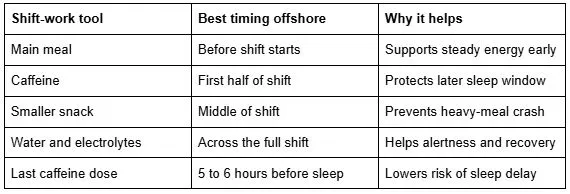
Overnight fueling works best when you front-load real food, hydrate steadily, and stop using late-shift caffeine that disrupts the next sleep block.
Avoid Fighting Your Next Sleep Block
That timing matters because caffeine is useful and easy to misuse. General fatigue guidance from CDC/NIOSH recommends avoiding caffeine at least 5 hours before bedtime. Offshore, that usually means deciding your cutoff before the shift starts.
Step 4: Stay Alert on Night Shift Without Ruining Sleep
Use Countermeasures Early
You stay alert offshore by using light, movement, hydration, and early caffeine before the slump instead of chasing it with late coffee. That may buy one decent hour and cost the next sleep block. It is more effective to build countermeasures into the shift:
- Use brighter light early in the shift if your work area allows it.
- Stand, walk, or change tasks before your eyelids start to feel heavy.
- Double-check higher-risk work during the circadian low.
- Keep hydration steady rather than chugging fluids only when you feel bad.
Keep Medication in the Right Context
If medication ever becomes part of the discussion, consult your healthcare provider first and keep the basics honest. Modafinil is indicated to improve wakefulness in adults with excessive sleepiness associated with shift work disorder. It is a wakefulness-promoting agent, not a replacement for sleep.
Tips for Best Results Offshore
Plan for the Hardest Window
CDC/NIOSH guidance says 15- to 30-minute naps can reduce fatigue during work hours. Use that as a tool, not as proof you can function on no sleep. If you know your hardest stretch is between 2 a.m. and 5 a.m., plan for it before midnight:
- Short pre-shift nap if you are rotating onto nights
- Early-shift bright light
- Mid-shift movement break
- Short nap if allowed and if warning signs are building
- Task pairing or cross-checking during the worst window
Act Before You Are Already Fading
Movement, light, and planned breaks work best when they are preventive. Once you are rereading the same line three times or forgetting simple handoff details, small tricks are no longer enough.
Common Mistakes to Avoid
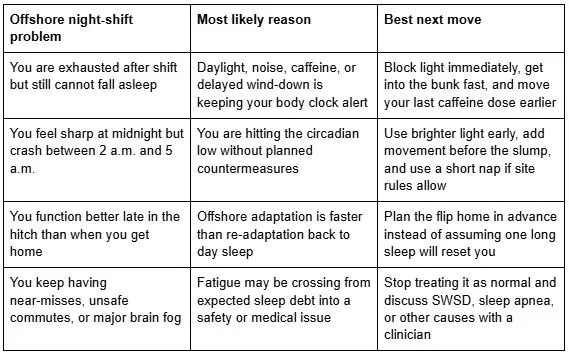
Fix the Pattern, Not Just the Symptom
Why the Post-Shift Trip Is So Dangerous
The Risk Does Not End at Handoff
The post-shift trip is dangerous because fatigue shows up when the adrenaline drops and attention narrows after work ends. CDC/NIOSH says motor vehicle crashes caused over 40% of work-related deaths in oil and gas extraction. Driver fatigue was one factor.
Treat Driving Warning Signs Seriously
If you feel yourself drifting on the commute, missing turns, fighting eyelid drops, or needing extreme stimulation to stay awake, treat that as a stop sign.
When to Talk to Your Doctor
Know When Fatigue Looks Like SWSD
SWSD is often part of the problem when you stay sleepy at work and cannot sleep after shift despite a disciplined routine.
A PMC review says SWSD affects 10% to 40% of people who work nontraditional shifts. The systematic review cited above found one older offshore petroleum prevalence study reported that 23.3% of swing-shift oil rig workers met criteria for shift work disorder.
Bring Specific Symptoms to the Visit
It is important to talk to a healthcare provider if:
- You stay dangerously sleepy on shift despite a real sleep plan.
- You cannot fall asleep after shift even when the bunk environment is controlled.
- You have repeated near-misses, memory lapses, or unsafe commutes.
- Loud snoring, choking, or morning headaches suggest sleep apnea may also be in play.
- You feel better late in the hitch and then crash hard every time you return home.
Ask About Treatment Options Carefully
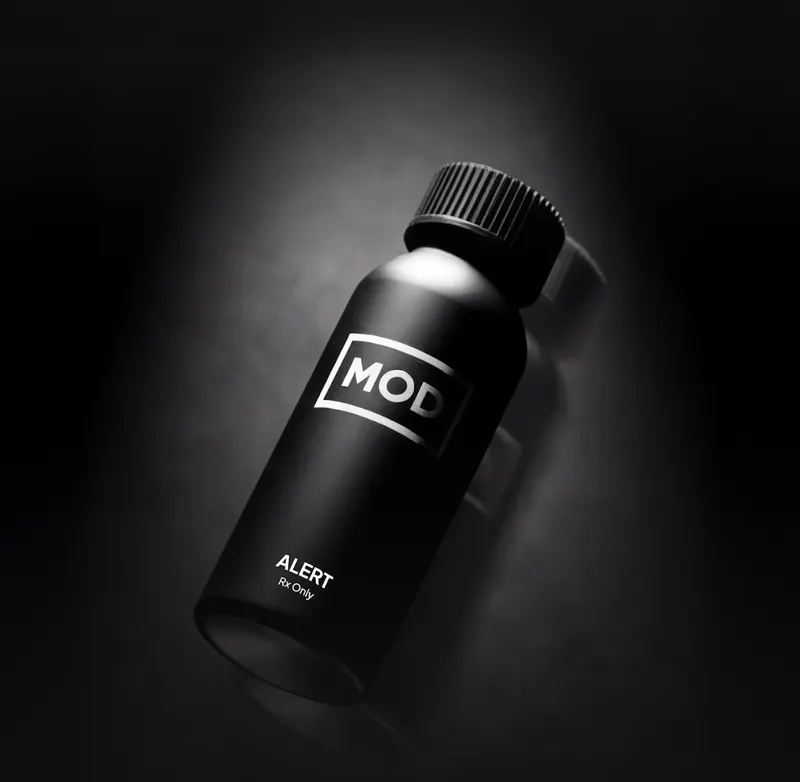
For workers who end up discussing treatment, MOD offers a telehealth prescription path built around shift workers. MOD Alert combines 150 mg modafinil with caffeine. MOD Focus combines 150 mg modafinil, 20 mg atomoxetine, and 60 mg caffeine. These are compounded medications delivered as prescription-strength drinks, not FDA-approved finished products.
How MOD Fits Offshore Shift-Work Fatigue
Match the Option to the Real Problem
There is no single best answer for every oil rig worker. The right choice depends on what is actually going wrong.
- If your main problem is an inconsistent routine, the strongest option is still a disciplined sleep-and-fatigue system.
- If you are consistently sleepy on shift, cannot sleep when you finally get to the bunk, and want a shift-specific telehealth prescription path, MOD may be a strong fit to discuss.
Where MOD Alert and MOD Focus Fit
MOD is built for shift workers rather than for general telehealth traffic. The most relevant option for offshore wakefulness support is MOD Alert, which combines 150 mg modafinil with caffeine. For workers whose provider also wants to address focus and cognitive performance, MOD Focus combines 150 mg modafinil, 20 mg atomoxetine, and 60 mg caffeine. Modafinil itself is FDA-approved for Shift Work Sleep Disorder, but MOD's finished products are compounded medications and are not FDA-approved as products.
Review Plans and Support
If your primary need is evaluating whether persistent offshore fatigue is ordinary sleep debt or a real SWSD pattern, MOD is worth a closer look. You can also review MOD plans, visit the MOD FAQ, or contact MOD for patient support.
Frequently Asked Questions
How do you sleep on an oil rig after a night shift?
You usually sleep better after a night shift when you reach the bunk quickly, block light, cool the room, and limit noise. The goal is to protect one repeatable sleep block instead of letting daylight, conversation, screens, or crew-change noise keep delaying bedtime after every shift.
Can naps help oil rig workers manage fatigue?
Short naps can help when they are planned before performance drops, not used as a last-minute rescue after fatigue takes over. CDC/NIOSH guidance says 15- to 30-minute naps can reduce fatigue during work hours, but naps should support a real sleep plan, not replace it.
Could SWSD explain offshore brain fog?
Shift Work Sleep Disorder can explain offshore brain fog when you stay sleepy during work hours and still cannot sleep afterward. It is especially worth discussing if the same pattern continues despite a protected sleep block, better caffeine timing, light control, and a more consistent bunk routine.
Why is the trip after shift such a big risk?
The post-shift trip is risky because attention often drops after work, especially after long, overnight, or rotating shifts. In oil and gas extraction, commutes can also be remote and monotonous, so eyelid drops, missed turns, or drifting should be treated as warning signs, not normal tiredness.
When should an oil rig worker see a doctor?
An oil rig worker should see a doctor when fatigue stays severe after schedule cleanup, driving feels unsafe, or symptoms suggest SWSD, sleep apnea, or another medical issue. Repeated near-misses, memory lapses, loud snoring, choking during sleep, or morning headaches are all reasons to get evaluated.
This article is provided for informational purposes only and does not constitute medical advice. The information presented is not a substitute for professional medical advice, diagnosis, or treatment. Always consult your healthcare provider to discuss the risks, benefits, and appropriateness of any treatment.
MOD offers access to healthcare providers who may prescribe compounded medications for the treatment of excessive daytime sleepiness associated with shift work sleep disorder (SWSD), when clinically appropriate.
The featured products include compounded medications that have not been approved by the FDA. Compounded medications may be prescribed under federal law but are not the same as, nor are they generic versions of, any FDA-approved medication. The FDA does not review compounded medications for safety, effectiveness, or manufacturing quality of compounded products. A prescription will only be written if deemed appropriate after the digital consultation by the licensed medical provider. Individual results may vary.
MOD is not a compounding pharmacy but a telemedicine service that links patients to licensed medical providers.