26 Sleep Deprivation Statistics: Data You Can't Ignore in 2026
Sleep deprivation statistics show that approximately 1 in 3 U.S. adults, 80 to 100 million people, regularly sleep fewer than the recommended 7 hours per night. The consequences include a 70% higher workplace accident rate, 21% of fatal vehicle crashes, $411 billion in annual economic losses, and elevated risks for obesity, diabetes, heart disease, and premature death.
This roundup compiles 29 verified sleep deprivation statistics from the CDC, NIH, RAND Corporation, and peer-reviewed journals indexed on PubMed. Whether you work nights, run on five hours out of habit, or manage a team where fatigue is the norm, here's what the data actually shows.
Key Takeaways
- 1 in 3 U.S. adults regularly gets less sleep than recommended, placing chronic sleep deprivation in the same category as obesity as a public health crisis.
- Sleep deprivation costs the U.S. economy up to $411 billion per year in lost productivity, absenteeism, and premature death, per RAND research.
- 72% of high school students get insufficient sleep, making adolescents the most sleep-deprived age group in America.
- Sleep-deprived employees are 70% more likely to be involved in workplace accidents than well-rested colleagues.
- Drowsy driving contributes to 21% of fatal crashes, rivaling alcohol as a road safety threat.
- Short sleep raises obesity risk by ~55% and type 2 diabetes risk by 28%, according to peer-reviewed metabolic research.
How Many Americans Are Losing Sleep?
1. 1 in 3 U.S. adults sleep less than recommended
CDC adult sleep data shows roughly one-third of American adults regularly fall short of the recommended 7 hours per night. That's not occasional bad nights, it's chronic, systemic sleep loss affecting tens of millions of people.
2. 50–70 million Americans have a chronic sleep disorder
The NIH estimates that between 50 and 70 million Americans are affected by ongoing sleep disorders, including insomnia, obstructive sleep apnea, and Shift Work Sleep Disorder.
3. Young adults have high short sleep rates
A 2020 analysis found that 29.7% of adults aged 18-24 reported sleeping less than the recommended minimum. Irregular schedules, screen exposure, and shift work converge for this age group in ways that erode sleep consistently.
4. Most shift workers can't hit the 7-hour target
The CDC and American Academy of Sleep Medicine both recommend at least 7 hours nightly for adults. For the roughly 40 million Americans working non-traditional schedules, hitting that target while sleeping against their natural circadian rhythm is structurally harder, not simply a matter of discipline.
Sleep Deprivation and Physical Health Statistics
5. Sleep loss is linked to 5 of the top 15 causes of death
Research published in PMC (2021) identified connections between poor sleep and five of the top 15 leading U.S. causes of death: cardiovascular disease, cerebrovascular disease, accidents, type 2 diabetes, and hypertension. Sleep is not optional maintenance, it is core physiological repair.
6. Short sleep raises cardiovascular disease risk by 9%
A 2023 systematic meta-analysis found that sleep deprivation carries a relative cardiovascular disease risk of 1.09. The risk is dose-dependent: less sleep, more damage, and it compounds over years.
7. Under 6.5 hours of sleep raises heart disease risk
Research on sleep duration and coronary heart disease identified a U-shaped relationship between sleep and heart risk, with the floor at 6.5 hours. Below that threshold, morbidity and mortality rates for coronary events climb measurably.
8. Sleep deprivation raises obesity risk by 55%
Meta-analytic data links sleep curtailment to a roughly 55% higher risk of obesity. The mechanism is hormonal: sleep loss suppresses leptin, which supports satiety signaling, and elevates ghrelin, which supports hunger signaling, pushing the appetite system toward overconsumption.
9. Partial sleep deprivation raises caloric intake by 20%
In controlled metabolic studies, subjects who were partially sleep-deprived increased caloric intake by roughly 20%, with a strong preference for high-carbohydrate and high-fat foods. This isn't willpower failure, it's hormonal.
10. Short sleep duration raises type 2 diabetes risk by 28%
A meta-analysis examining sleep and diabetes found that short sleepers face a 28% higher likelihood of developing type 2 diabetes compared to adequate sleepers. Chronic sleep loss reduces insulin sensitivity, setting the stage for resistance over time.
11. Sleep loss triggers inflammation and impairs immunity
Research in PMC (2021) found that inadequate sleep alters cytokine levels, leukocyte counts, and acute-phase proteins, markers associated with systemic inflammation. This low-grade inflammation increases susceptibility to infection and accelerates metabolic disease.
Sleep Deprivation and Mental Health Statistics
Sleep deprivation is the most underappreciated driver of poor mental health. The relationship is bidirectional: poor sleep worsens mood, and poor mood disrupts sleep.
12. 46% of poor sleepers rate their mental health as poor
The Sleep Foundation's survey data found that nearly half of poor sleepers report poor mental health, compared to just 11% of people with above-average sleep quality.
13. Poor sleepers have 3x the rate of poor mental health
In the same Sleep Foundation research, poor sleepers reported sleeping nearly an hour less per night than good sleepers (6.3 hours vs. 7.2 hours) and were three times as likely to describe their mental health as poor.
14. Better sleep quality reduces depression and anxiety
A meta-analysis of 65 randomized controlled trials found that interventions targeting sleep quality produced medium-to-large improvements in depression, anxiety, and overall mental health, independent of other treatments. Sleep isn't just a symptom of mental health conditions; it's a lever for improving them.
15. Adolescents under 8 hours face 3x higher suicide risk
A prospective study found that adolescents sleeping less than 8 hours per night had roughly three times the rate of suicidal ideation and attempts compared to peers sleeping 9 or more hours. In younger populations, the mental health stakes of sleep deprivation are acute.
What Does Sleep Deprivation Cost the U.S. Economy?
16. U.S. loses up to $411 billion per year to sleep loss
The most widely cited economic analysis, published by the RAND Corporation, puts annual U.S. losses at between $280 billion and $411 billion, roughly 2.28% of GDP. These losses flow from absenteeism, presenteeism, and premature mortality.
17. Sleep loss erases 1.2 million working days per year
The same RAND research calculated that chronic sleep deficiency eliminates approximately 1.2 million working days annually, a large productivity loss spread across the workforce each year.
18. Sleep deprivation raises mortality risk by 13%
Beyond the productivity numbers, RAND's cross-country analysis found that chronic sleep loss is associated with a 13% increased mortality risk. The cost isn't just economic, it's measurable in years of life.
19. One more hour of sleep could add $226 billion to GDP
One of the more striking findings from RAND's modeling: even a modest improvement, going from under 6 hours to 6-7 hours per night, could add $226.4 billion to U.S. economic output annually. The ROI on sleep is measurable and large.
Workplace Accidents and Occupational Hazards
Workplace fatigue is a major preventable contributor to occupational injury in industries where alertness is essential, including healthcare, transportation, and manufacturing.
20. Sleep-deprived workers face 70% higher accident risk
Sleep Foundation's workplace safety data shows that excessively sleepy workers are 70% more likely to be involved in a workplace accident than their well-rested counterparts. The risk scales with severity, the less sleep, the higher the hazard.
21. Shift workers face 3x higher occupational accident risk
NIH research on shift work hazards found that night and rotating shift workers face accident rates two to three times higher than day shift workers. Hospital workers on afternoon or night shifts face measurably higher incident rates than colleagues on day rotations.
22. Night shift nurses make 32% more mathematical errors
A controlled study of 100 nurses found that cognitive accuracy, specifically mathematical performance, dropped 32% for night shift nurses compared to day shift peers. In healthcare settings where dosing depends on precise calculations, that gap has direct patient safety implications.
Sleep Deprivation Behind the Wheel
23. Drowsy driving contributes to 21% of fatal crashes
NHTSA reports that driver fatigue is a factor in approximately 21% of all fatal motor vehicle crashes. Because drowsy driving leaves no physical trace, unlike alcohol, the true figure is likely underreported in crash data.
24. Sleeping 6 hours or less raises crash risk by 33%
Research reviewed by the Sleep Foundation found that sleeping 6 hours or fewer raises crash risk by 33% compared to getting 7-8 hours. The relationship is dose-dependent: cut more sleep, add more risk.
Shift Work Sleep Disorder: When Your Job Disrupts Sleep
25. About 25% of U.S. workers work non-traditional hours
Roughly one in four American workers works evenings, nights, early mornings, or rotating schedules. That's approximately 40 million people whose sleep-wake patterns are structurally misaligned with their biology, not by choice, but by occupation.
26. Modafinil improved 74% of SWSD patients vs. 36% placebo
In a randomized, double-blind trial of 209 patients with Shift Work Sleep Disorder, 74% of patients treated with modafinil 200 mg showed clinically meaningful improvement compared to 36% on placebo.
Modafinil is a wakefulness-promoting agent FDA-approved for Shift Work Sleep Disorder since 2004, with a Schedule IV classification indicating lower abuse potential than Schedule II stimulants like Adderall.
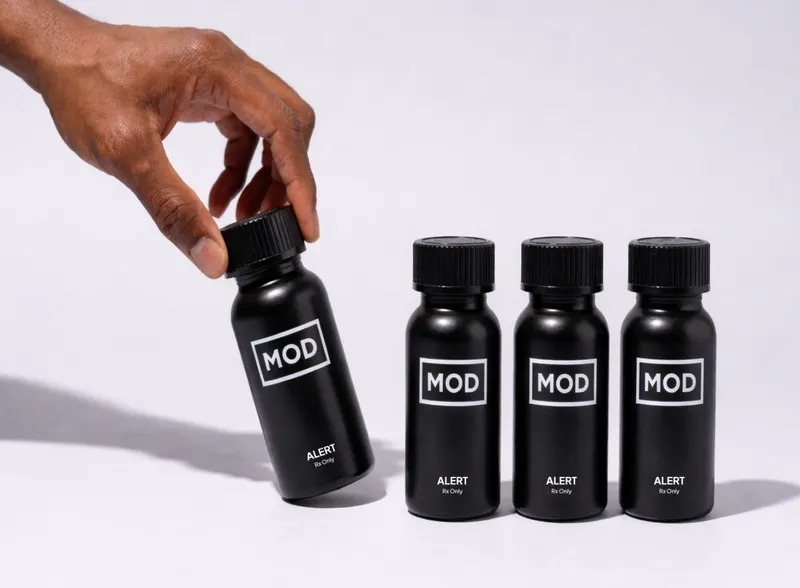
For shift workers managing SWSD, MOD Alert is a compounded prescription-strength drink containing modafinil 150 mg and caffeine, designed to support sustained wakefulness during night and rotating shifts. As a compounded medication, MOD Alert is not FDA-approved as a product, but modafinil, its active ingredient, carries FDA approval specifically for SWSD.

What This Means for You
The data is consistent: sleep deprivation is not a badge of productivity. It's a measurable health, safety, and economic liability, one that falls hardest on shift workers and people in their peak working years.
If you work irregular hours and fight exhaustion mid-shift, that experience has a clinical name, Shift Work Sleep Disorder, with evidence-based solutions: circadian light therapy, behavioral sleep strategies, and wakefulness-promoting medications available through a telehealth provider.
A common mistake: treating chronic fatigue as a discipline problem rather than a circadian one. Pushing through on willpower doesn't address the metabolic and cognitive risks associated with chronic short sleep.
If SWSD might be affecting your performance and safety, a telehealth provider can review your intake and, if appropriate, ship a prescription directly to your door.
Frequently Asked Questions
How many Americans suffer from sleep deprivation?
About 1 in 3 U.S. adults, roughly 80-100 million people, regularly get less than the recommended 7 hours of sleep per night, per CDC data. An estimated 50 to 70 million Americans are affected by chronic sleep disorders.
What health risks does sleep deprivation cause?
Short sleep is linked to cardiovascular disease, type 2 diabetes, obesity, impaired immunity, and premature mortality. In the immediate term, it raises workplace accident risk by 70% and contributes to 21% of fatal vehicle crashes. Sleep deprivation has been linked to five of the top 15 leading causes of death in the United States.
How does sleep deprivation affect mental health?
Research consistently shows a bidirectional relationship: poor sleep worsens mental health, and poor mental health disrupts sleep. Nearly half of people with below-average sleep quality report poor mental health. Improving sleep quality through behavioral or medical interventions has been shown in meta-analyses to produce significant reductions in depression and anxiety.
What is Shift Work Sleep Disorder (SWSD)?
SWSD is a circadian rhythm disorder affecting people working night or rotating shifts. It's characterized by excessive sleepiness during work hours and an inability to sleep adequately during scheduled rest.
How does sleep deprivation affect the brain?
Sleep deprivation impairs the prefrontal cortex (decision-making, impulse control), hippocampus (memory consolidation), and amygdala (emotional regulation). After 17-19 hours without sleep, cognitive performance is equivalent to a blood alcohol level of 0.05%. After 24 hours awake, impairment matches a BAC of 0.10%, legally intoxicated in every U.S. state, with measurable declines in attention, working memory, and processing speed.
This article is provided for informational purposes only and does not constitute medical advice. The information presented is not a substitute for professional medical advice, diagnosis, or treatment. Always consult your healthcare provider to discuss the risks, benefits, and appropriateness of any treatment.
MOD offers access to healthcare providers who may prescribe compounded medications for the treatment of excessive daytime sleepiness associated with shift work sleep disorder (SWSD), when clinically appropriate.
The featured products include compounded medications that have not been approved by the FDA. Compounded medications may be prescribed under federal law but are not the same as, nor are they generic versions of, any FDA-approved medication. The FDA does not review compounded medications for safety, effectiveness, or manufacturing quality of compounded products. A prescription will only be written if deemed appropriate after the digital consultation by the licensed medical provider. Individual results may vary.
MOD is not a compounding pharmacy but a telemedicine service that links patients to licensed medical providers.