Shift Work Sleep Disorder Symptoms Checklist (2026)

If you are wiped out during your shift and then wide awake when you get home, this checklist can help. It can show whether you may be dealing with more than ordinary fatigue. Shift Work Sleep Disorder (SWSD) is a real circadian rhythm condition that shows up when your work hours keep colliding with your normal sleep window.
If you are searching for a checklist, you are probably trying to answer a simple question: "Is this just night-shift fatigue, or is something off?" Use this guide to screen for the most common symptoms, spot safety red flags, and decide when it is time to bring the pattern to a provider.
Based on Cleveland Clinic, Sleep Foundation, OSHA, StatPearls, and PubMed data, insomnia plus excessive sleepiness is the main symptom pattern that deserves a closer look.
Key Takeaways
- The two core Shift Work Sleep Disorder symptoms are insomnia during your sleep window and excessive sleepiness during work hours.
- This shift work sleep disorder symptoms checklist is most useful when your sleep problems keep tracking with your work schedule.
- About 20% of the U.S. full-time workforce does some form of shift work, so this is not a niche problem.
- Diagnosis is not based on one rough week. StatPearls notes that symptoms should be tied to the schedule, reduce total sleep time, last at least 3 months, and cause impairment or distress.
- Safety matters early. OSHA says accident and injury rates are 30% higher on night shifts than day shifts.
Why It Matters Now
People usually look for a SWSD checklist when the pattern stops feeling temporary. Sleep Foundation reports that people with shift work disorder lose an average of 1 to 4 hours of sleep per night, and OSHA says injury rates are higher on evening and night shifts. Once fatigue starts hitting concentration, mood, or the drive home, it is important to treat it like a health and safety issue, not just a rough schedule.
Shift Work Sleep Disorder Symptoms Checklist
Shift work sleep disorder symptoms usually show up as insomnia when you try to sleep and excessive sleepiness when you need to work. Reduced total sleep and symptoms that keep tracking with your shift schedule over time round out the pattern. If that pattern is also hurting concentration, mood, or safety, it is worth a medical review.
Run through these yes-or-no items. If this checklist sounds like your routine, it is worth bringing the pattern to a healthcare provider.
Quick Self-Check
- [ ] You regularly cannot fall asleep or stay asleep when your schedule says it is time to sleep, which matches Cleveland Clinic's insomnia description for SWSD.
- [ ] You feel excessively sleepy during your night shift, early-morning shift, or commute home.
- [ ] Your symptoms are clearly tied to your work hours, not showing up the same way on vacations or normal day schedules.
- [ ] You are getting less total sleep overall, not just sleeping at a different time of day.
- [ ] You are making more mistakes, zoning out, or struggling to focus at work.
- [ ] You are also dealing with headaches, low energy, irritability, or poor mood.
- [ ] The pattern has lasted at least 3 months, or it predictably returns whenever you work nights or rotating shifts.
- [ ] Your symptoms are affecting work performance, safety, relationships, or your ability to function off shift.
Reading Each Signal
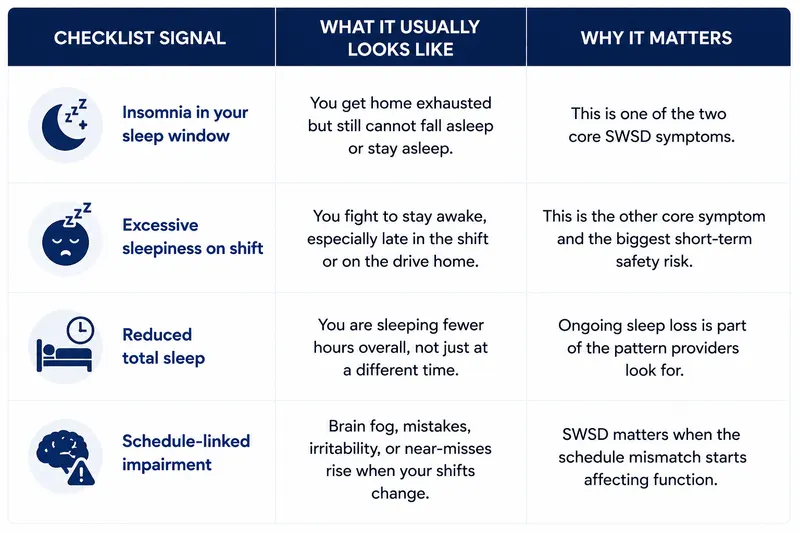
What Are the Core Symptoms of Shift Work Sleep Disorder?
The core symptoms of Shift Work Sleep Disorder are insomnia during your planned sleep window and excessive sleepiness when you need to stay alert. Cleveland Clinic describes those as the main signs, and StatPearls adds that the sleep loss has to track with work hours overlapping your usual sleep time. That timing pattern helps separate SWSD from ordinary fatigue after a rough week.
When Does Night-Shift Fatigue Cross the Line Into SWSD?
Night-shift fatigue crosses into SWSD when it keeps recurring with your work schedule, cuts total sleep, lasts for months, and starts impairing safety or function. StatPearls notes that diagnosis includes insomnia and or excessive sleepiness, reduced total sleep time, symptoms lasting at least 3 months, and meaningful distress or impairment. Sleep Foundation also notes that workers usually show disturbed sleep-wake patterns for at least 2 weeks through sleep logging or actigraphy.
The Secondary Symptoms That Often Show Up With SWSD
Secondary symptoms do not define SWSD by themselves, but they often show up once the sleep disruption starts affecting the rest of your day. Cleveland Clinic lists trouble concentrating, headaches, low energy, poor mood, decreased alertness, and irritability as common add-on symptoms. When those problems rise and fall with your shifts, they strengthen the case that the issue is circadian rather than just stress.
How Doctors Diagnose Shift Work Sleep Disorder
Doctors diagnose Shift Work Sleep Disorder by matching schedule-linked insomnia or sleepiness to symptom duration, reduced sleep time, and real-world impairment. Sleep Foundation says workers being evaluated for shift work disorder should report recurring symptoms for at least 3 months and document sleep-wake disruption for at least 2 weeks through sleep logging or actigraphy. Your checklist answers can help show the pattern. A sleep study or other testing may be used to rule out another cause, such as sleep apnea or medication side effects.
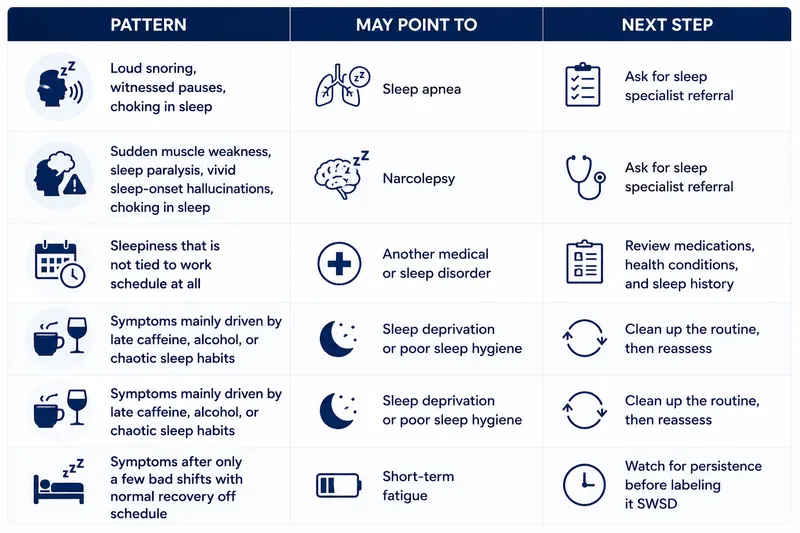
Symptoms That May Point to Another Sleep Problem Instead
Some symptoms fit SWSD poorly and should push the conversation toward another diagnosis rather than a straight shift-work explanation:
Why SWSD Symptoms Can Become a Work-Safety Risk
SWSD becomes a safety risk when sleepiness starts slowing reaction time, increasing mistakes, or making the drive home feel harder than the shift itself. OSHA says accident and injury rates are 18% higher on evening shifts and 30% higher on night shifts than day shifts, and working 12 hours per day is associated with a 37% increased risk of injury.
If your checklist includes nodding off on the commute, forgetting the last few miles of driving, or repeated near-misses, that is a warning sign, not a badge of toughness.
A 2-Week Sleep Log You Can Bring to Your Provider
Sleep Foundation says sleep logging and actigraphy are often part of diagnosis because they show what is happening across workdays and days off. Keep your log simple:
- Shift start and end time
- Commute time
- Time you got into bed
- Estimated time it took to fall asleep
- Wake-ups during sleep
- Final wake time
- Naps
- Caffeine, alcohol, or sleep-aid timing
- Moments of severe sleepiness, mistakes, or microsleeps
Bring 14 days if you can. A 2-week sleep log is a useful document to bring to a provider after a schedule-linked sleep problem starts repeating.
Treatment Options for Shift Work Sleep Disorder
Treatment for Shift Work Sleep Disorder usually combines schedule changes, light management, sleep support, and sometimes prescription medication. Cleveland Clinic lists bright light therapy, melatonin, short-term sleep medications, and wakefulness-promoting agents as common tools.
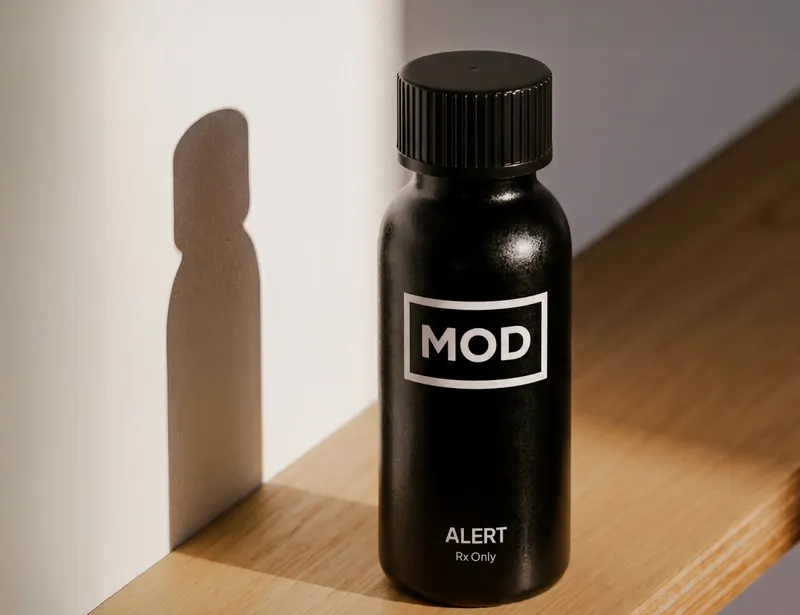
1. MOD Alert: Shift-Worker-Specific Telehealth Option
If you want a shift-worker-specific telehealth prescription path, MOD Alert contains Modafinil 150 mg plus 60 mg caffeine in a compounded prescription-strength drink designed for Shift Work Sleep Disorder. MOD's telehealth prescription process is built around online intake, provider review, and shipping to your door. Modafinil is FDA-approved as an active ingredient for excessive sleepiness associated with Shift Work Sleep Disorder. MOD products are compounded medications.
Pros
- Purpose-built around shift workers instead of broad telehealth categories.
- Combines modafinil with caffeine in a compounded prescription-strength drink designed for sustained alertness.
- Telehealth prescription flow is straightforward: online intake, provider review, then shipping to your door.
Best For
Workers who want a provider-reviewed, shift-worker-specific prescription option for sustained wakefulness during long or overnight shifts.
2. Sleep and Light Routine Reset: First-Line Foundation
Protect a real daytime sleep window, reduce light exposure before bed, and use timed light to support alertness during work hours.
Pros
- Addresses the circadian mismatch instead of only masking sleepiness.
- Low cost and commonly recommended even when medication is later added.
Best For
Workers with early or moderate symptoms who need a base strategy before deciding whether prescription treatment is worth discussing.
3. Melatonin and Sleep Support for Sleep Timing
Melatonin is often used to support daytime sleep timing, especially when falling asleep after a shift is the bigger problem.
Pros
- Accessible and familiar to many workers.
Best For
Workers whose biggest issue is getting to sleep after work rather than staying awake once the shift starts.
4. Prescription Wakefulness Medication
PubMed documents a 3-month randomized trial in 209 patients with SWSD. In that study, modafinil 200 mg before shifts reduced extreme sleepiness and produced a small but significant performance improvement versus placebo.
Prescription wakefulness-promoting medication is a leading option when excessive sleepiness is becoming a safety problem. Modafinil is a non-amphetamine wakefulness-promoting agent, not a Schedule II stimulant.
Pros
- Directly targets excessive sleepiness when SWSD is affecting work function.
Best For
Workers with persistent, schedule-linked sleepiness who have already tried sleep and light strategies or whose jobs have real alertness demands.
Best Practices for Managing SWSD Symptoms
- Keep your sleep and wake times as consistent as your job allows, even on days off.
- Make your sleep space dark, cool, and quiet so your body gets a real daytime sleep window.
- Track caffeine, naps, and severe sleepiness for 2 weeks before an assessment.
- Ask for a medical review if symptoms keep repeating for 3 months or start affecting work, mood, or safety.
- Seek urgent care right away if sleepiness is making driving or job-site tasks unsafe.
Common Mistakes That Keep SWSD Going
- Treating every bad shift like a caffeine problem instead of a sleep-timing problem
- Writing off headaches, irritability, and brain fog as personality or stress
- Letting days off turn into total schedule chaos
- Ignoring snoring, choking, or sleep paralysis signs that suggest something other than SWSD
- Waiting until a near-miss or commute scare before taking symptoms seriously
The goal is recognizing when your pattern has crossed from hard schedule to medical issue. Those habits can keep the pattern hidden for weeks and delay better treatment decisions.
How MOD May Help Shift Workers With SWSD Symptoms
MOD is built around the reality that shift workers often need more than generic sleep advice. Better sleep timing, darker daytime sleep, and light management are still the foundation, but some workers continue to struggle with excessive sleepiness during overnight or rotating shifts even after improving the basics.
For eligible patients, MOD offers a telehealth prescription path with provider review and compounded medication options designed for Shift Work Sleep Disorder. MOD Alert is centered on Modafinil 150 mg plus caffeine for wakefulness support during demanding shifts. It is not a substitute for diagnosis, sleep protection, or a provider's judgment, but it may be a practical option for shift workers whose symptoms are affecting performance, safety, or day-to-day function.

Frequently Asked Questions
What are the symptoms of shift work sleep disorder?
The main symptoms are insomnia during your planned sleep window and excessive sleepiness during work hours. Some people also notice headaches, irritability, trouble concentrating, low energy, or brain fog. Those secondary symptoms matter most when they rise and fall with night shifts, rotating shifts, or early-morning schedules.
How is shift work sleep disorder diagnosed?
Providers diagnose SWSD by connecting your work schedule to insomnia or sleepiness, reduced total sleep, and real-world impairment. They may ask for a sleep log or actigraphy for at least 2 weeks. They may also review medications, sleep habits, and other sleep disorders before confirming the pattern.
How do you tell SWSD from regular insomnia?
SWSD tracks closely with nontraditional work hours, while regular insomnia can happen on any schedule. If symptoms improve when you are away from night shifts or rotating shifts, that supports a schedule-linked problem. If sleep difficulty continues no matter what your schedule looks like, another insomnia pattern may be involved.
When does night-shift fatigue become a safety issue?
It becomes a safety issue when you are nodding off, making unusual mistakes, drifting while driving, or feeling dangerously sleepy on the commute home. Those signs suggest the problem has moved beyond normal tiredness. At that point, it is important to stop treating fatigue as something to simply push through.
What treatment usually helps shift workers first?
Most shift workers start with a tighter sleep schedule, darker daytime sleep conditions, better light timing, planned naps, and smarter caffeine timing. If those basics are not enough and sleepiness keeps affecting work or safety, prescription wakefulness medication may be worth discussing with a healthcare provider.
This article is provided for informational purposes only and does not constitute medical advice. The information presented is not a substitute for professional medical advice, diagnosis, or treatment. Always consult your healthcare provider to discuss the risks, benefits, and appropriateness of any treatment.
MOD offers access to healthcare providers who may prescribe compounded medications for the treatment of excessive daytime sleepiness associated with shift work sleep disorder (SWSD), when clinically appropriate.
The featured products include compounded medications that have not been approved by the FDA. Compounded medications may be prescribed under federal law but are not the same as, nor are they generic versions of, any FDA-approved medication. The FDA does not review compounded medications for safety, effectiveness, or manufacturing quality of compounded products. A prescription will only be written if deemed appropriate after the digital consultation by the licensed medical provider. Individual results may vary.
MOD is not a compounding pharmacy but a telemedicine service that links patients to licensed medical providers.