Red Bull Gives You Wings, And Then Anxiety. Here's the Best Red Bull Alternative in 2026
You crack open a Red Bull at 6 AM. By 10 AM, your heart is racing, your hands are slightly shaky, and you're staring down a productivity cliff. This is not a character flaw, it is how short-acting stimulant drinks can feel for some people. Red Bull contains 80 mg of caffeine per can, and many people find that the boost is relatively short-lived compared with longer-acting options. For shift workers, night owls, or anyone looking for a Red Bull alternative that lasts past noon, that's a real problem.
The good news: in 2026, your options for a Red Bull alternative have expanded well beyond switching to a different flavored can. From prescription-grade compounded medications to clean OTC options, this guide covers six alternatives honestly — including real pros, cons, and who each one is actually right for.
Key Takeaways
- MOD Alert is a prescription option for sustained wakefulness that combines modafinil with caffeine. It requires provider approval through MOD's online process.
- Celsius is one OTC energy drink alternative people often consider. It has no added sugar and about 200 mg of caffeine per can.
- Matcha + L-theanine is a lower-caffeine option that some people find smoother than standard energy drinks.
- Black coffee is a simple alternative that gives you caffeine without added sugar.
- Caffeine + L-theanine capsules are a lower-cost OTC option some people use for more balanced focus.
- Electrolyte drinks solve dehydration-based fatigue — not a caffeine replacement, but useful as a complement.
Why People Are Looking for a Red Bull Alternative
The anxiety trigger. A PMC review on energy drinks and mental health found consistent associations between energy drink consumption and anxiety, depression, and stress. For people who are sensitive to stimulant drinks, the combination of caffeine and other ingredients can feel overstimulating, especially during stressful situations.
The short-lived boost. Many energy drinks wear off well before the end of a long shift. For someone working 10 to 12 hours, that can mean a noticeable drop in energy partway through the day.
The jitters. Some people feel overstimulated after energy drinks and end up with a pounding heart, shakiness, or trouble concentrating. That can make a quick boost feel counterproductive.
Cost and fit. At $2.50–$4 per can daily, the habit adds up — and a branded energy drink isn't engineered for reliable shift-work performance.
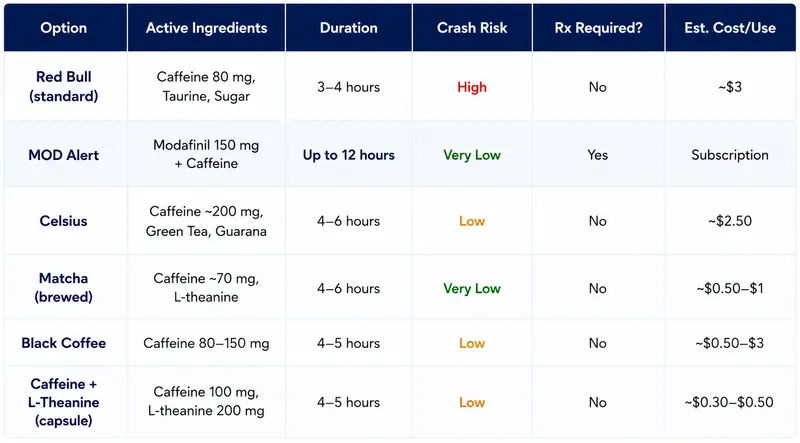
Quick Comparison: Red Bull vs. 6 Alternatives
1. MOD Alert — Prescription-Grade Wakefulness
Active ingredients: MOD Alert — Modafinil 150 mg + Caffeine 60 mg
Duration: 12–15 hours
Scheduling: Modafinil is Schedule IV (lower abuse potential); Atomoxetine is non-scheduled
Format: Compounded prescription-strength liquid drink
Rx required: Yes — via telehealth online assessment
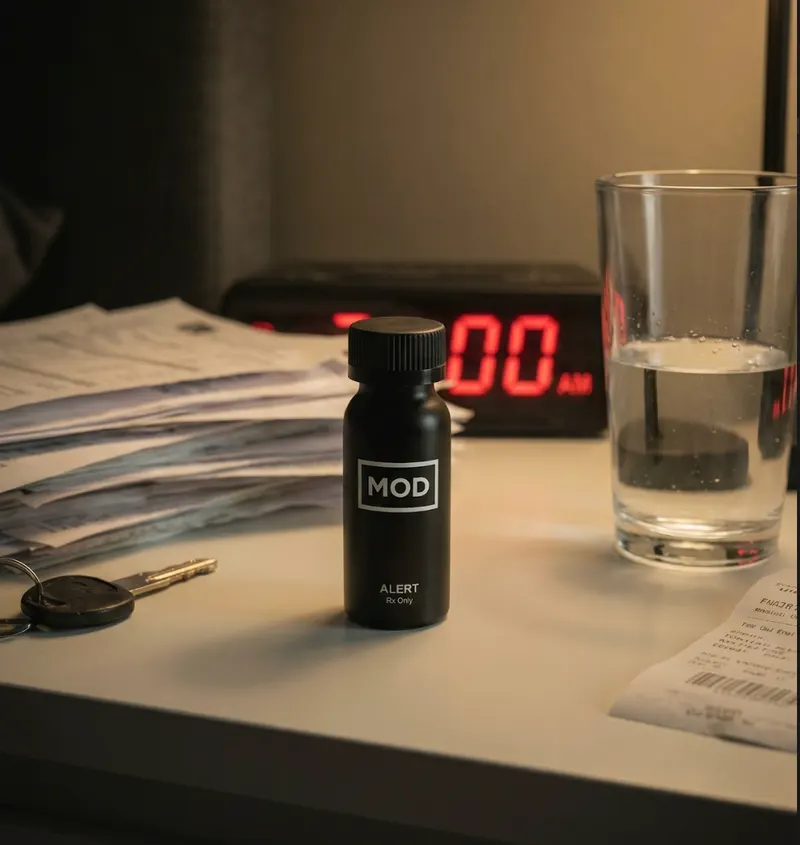
MOD represents a fundamentally different category from everything else on this list. Rather than stacking sugar and high-dose caffeine for a short burst, MOD Alert is built around Modafinil — a wakefulness-promoting agent that is FDA-approved for narcolepsy and Shift Work Sleep Disorder (SWSD).
How does Modafinil work differently from caffeine? Caffeine mainly works by blocking adenosine receptors, while Modafinil affects several brain chemicals involved in wakefulness and alertness, including dopamine, serotonin, norepinephrine, histamine, glutamate, and orexin. That broader mechanism is part of why Modafinil is often described as a longer-lasting wakefulness medication rather than a typical quick-hit stimulant.
The liquid format matters, too. MOD is offered as a prescription drink, and its liquid formulation may allow for quicker absorption than traditional pills.
Key Features
- Non-amphetamine mechanism — Schedule IV with significantly lower abuse potential than Schedule II stimulants like Adderall
- Telehealth prescription — complete an online assessment, a licensed provider reviews your intake, and your medication ships to your door
- Purpose-built for Shift Work Sleep Disorder (SWSD) — the FDA-approved indication for Modafinil as an active ingredient
Pros
- Longest duration of any option on this list
- Prescription oversight ensures appropriate dosing
- No sugar, reduced crash
Best For: Shift workers, healthcare professionals, pilots, truck drivers, or anyone who needs sustained focus for 10+ hours without a crash. Also well-suited for people whose anxiety is specifically triggered by high-caffeine energy drinks.
See if MOD is right for you — take the online assessment →
2. Celsius
Active ingredients: Caffeine ~200 mg, green tea extract, guarana, B vitamins
Duration: 4–6 hours
Scheduling: OTC, no prescription
Cost: ~$2–$2.50 per can
Celsius markets itself as a health-focused energy drink, and compared to Red Bull, it earns some of that positioning. The most meaningful difference: no added sugar. Without the glucose spike, the energy curve is smoother and the crash is less severe than a standard Red Bull. The caffeine dose (around 200 mg) is higher than Red Bull's 80 mg — closer to two cups of coffee in one can.
Key Features
- No added sugar — removes the glucose-crash component entirely
- ~200 mg caffeine — 2.5× Red Bull's dose, with guarana and green tea extract as supporting stimulants
- OTC, widely available — convenience stores, gyms, Amazon; no subscription or prescription needed
Pros
- No added sugar — avoids the glucose-related crash component
- Cleaner ingredient profile than traditional energy drinks
- OTC and widely available; no subscription required
3. Matcha / Green Tea
Active ingredients: Caffeine ~70 mg per serving, L-theanine ~30–40 mg
Duration: 4–6 hours
Cost: ~$0.50–$1 per cup (brewed)
Matcha's signature effect is calm focus — the opposite of the jittery anxiety that drives people to search for Red Bull alternatives. The combination of moderate caffeine and L-theanine (an amino acid that promotes alpha brain waves) creates a smoother, more sustained alertness without the spike-and-crash pattern.
L-theanine modulates caffeine rather than eliminating it. Research published in Nutritional Neuroscience found caffeine + L-theanine improved attention and reaction time versus caffeine alone — while reducing self-reported anxiety.
Key Features
- Natural L-theanine content (~30–40 mg per serving) — the ingredient missing from most commercial energy drinks
- ~70 mg caffeine per cup — moderate dose that avoids the adrenal spike Red Bull triggers
- No sugar, no artificial ingredients — as prepared (matcha powder + water)
Pros
- L-theanine reduces caffeine-related anxiety and jitter
- Very low cost per serving
- No sugar if prepared without sweetener
- Well-researched, long-use safety record
4. Black Coffee
Active ingredients: Caffeine 80–150 mg per 8 oz (varies significantly)
Duration: 4–5 hours
Cost: ~$0.50 home-brewed to ~$3 café
Coffee doesn't get enough credit as a Red Bull alternative — probably because it feels too obvious. The caffeine pharmacology is effectively identical to Red Bull's stimulant mechanism. What's different: no taurine, no artificial colors, no sugar. Black coffee is a cleaner delivery vehicle for the same active molecule, with decades of safety data behind it.
The Red Bull crash has two components: caffeine half-life AND the blood sugar drop from ~27 g of sugar per can. Black coffee eliminates the second component entirely.
Key Features
- No sugar or additives — eliminates the glucose-crash component of the Red Bull cycle
- Highly adjustable dose — 80–300 mg caffeine depending on brew method and size
- Decades of safety research — the most studied dietary stimulant available OTC
Pros
- No added sugar in plain form
- Available everywhere, very inexpensive
- Decades of safety research behind it
5. Caffeine + L-Theanine Stack (Capsule)
Active ingredients: Caffeine 100–200 mg + L-theanine 200–400 mg (1:2 ratio standard)
Duration: 4–5 hours
Cost: ~$0.30–$0.50 per dose (capsule)
If you want the anxiety-buffering benefits of matcha at a precise, higher dose, the caffeine + L-theanine capsule stack is the most controlled way to get there. The 1:2 caffeine-to-L-theanine ratio shows up consistently in research as the sweet spot for reducing anxiety while preserving cognitive sharpness.
This is a category, not a single product. Available as combined capsules from many manufacturers, or as separate powders you can dose individually. OTC, inexpensive, easy to adjust.
Key Features
- 1:2 caffeine-to-L-theanine ratio — the research-backed sweet spot for focused, jitter-free energy
- Precise dose control — choose your exact caffeine and L-theanine amounts; adjust as needed
- ~$0.30–$0.50 per dose — the most cost-efficient OTC option on this list
Pros
- Precise dose control
- L-theanine reduces anxiety and jitter from caffeine
- Very inexpensive
- No sugar, no artificial ingredients
- Portable and travel-friendly
6. Electrolyte Drinks (LMNT, Nuun, Liquid IV)
Active ingredients: Sodium, potassium, magnesium; some versions include light caffeine or B vitamins
Duration: Depends on formula — most have no primary stimulant
Cost: ~$1.50–$2.50 per packet
Electrolyte drinks belong on this list because a meaningful portion of afternoon fatigue is caused by dehydration rather than caffeine deficiency. Research consistently shows that even mild dehydration — 1–2% body weight loss — measurably impairs cognitive performance, reaction time, and mood.
Products like LMNT, Nuun, and Liquid IV address the hydration component directly. For shift workers who reach for Red Bull more out of ritual than pharmacological need, resolving dehydration can close a surprising amount of the gap. That said, electrolytes alone won't maintain wakefulness if you're genuinely sleep-deprived — they're best used alongside a primary wakefulness strategy.
Key Features
- Replaces sodium, potassium, and magnesium lost during long shifts — the electrolytes most depleted by extended activity
- Zero stimulant side effects — no jitters, no anxiety, no crash
- Widely available OTC — LMNT, Nuun, and Liquid IV sold at most grocery and health retailers
Pros
- Addresses dehydration as a fatigue driver
- No jitters, no crash
- Affordable and widely available
- Many versions are sugar-free
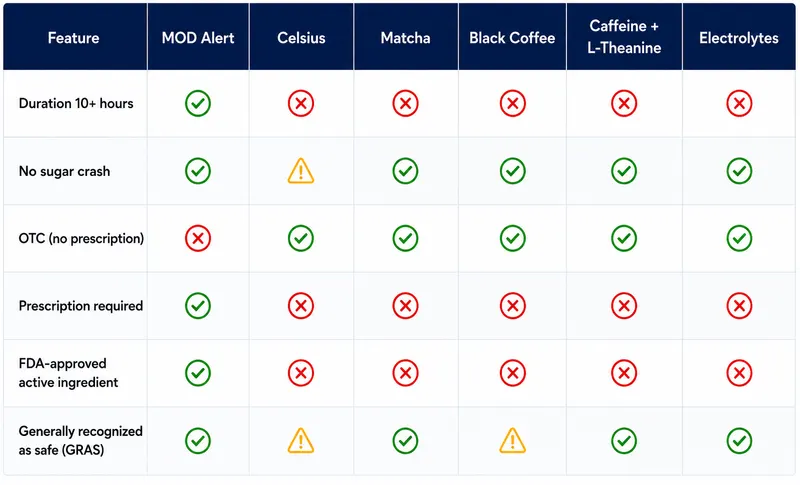
Side-by-Side Feature Matrix
Final Verdict
For people dealing with excessive sleepiness tied to shift work, MOD Alert is a prescription option built around modafinil, which is FDA-approved as an active ingredient for shift work sleep disorder. MOD's finished drinks themselves are compounded medications and are not FDA-approved.
Frequently Asked Questions
What makes Red Bull cause anxiety?
Some people feel anxious or overstimulated after energy drinks. Sensitivity varies, but caffeine-containing drinks can feel too intense for some users, especially under stress.
Is Celsius actually better than Red Bull?
For most people, yes. Celsius removes the added sugar and uses cleaner stimulant sources. At ~200 mg caffeine it's stronger than Red Bull's 80 mg — but that dose can still cause anxiety in sensitive individuals. Celsius mainly solves the crash, not the anxiety.
What is a healthier Red Bull alternative for shift work?
For shift work and shift work sleep disorder, MOD Alert is a prescription options on this list built around modafinil for extended wakefulness.
Can you get modafinil without going to a doctor's office?
Yes. MOD uses a telehealth prescription model — complete an online assessment, a licensed provider reviews your intake, and if approved, your prescription ships directly to your door. No in-person visit required.
Is modafinil safe as a Red Bull alternative?
Modafinil is FDA-approved for Shift Work Sleep Disorder and is Schedule IV with a well-established safety profile. It's important to complete a provider assessment first — there are contraindications for certain cardiovascular conditions and potential drug interactions.
What is the cheapest Red Bull alternative?
The caffeine + L-theanine capsule stack is the most cost-efficient at $0.30–$0.50 per dose — roughly 5–10x cheaper than a can of Red Bull. Black coffee brewed at home runs $0.25–$0.50 per cup. Matcha powder ($0.50–$1 per cup) is the most affordable drink format. All three outperform Red Bull on both cost and crash risk.
This article is provided for informational purposes only and does not constitute medical advice. The information presented is not a substitute for professional medical advice, diagnosis, or treatment. Always consult your healthcare provider to discuss the risks, benefits, and appropriateness of any treatment.
MOD offers access to healthcare providers who may prescribe compounded medications for the treatment of excessive daytime sleepiness associated with shift work sleep disorder (SWSD), when clinically appropriate.
The featured products include compounded medications that have not been approved by the FDA. Compounded medications may be prescribed under federal law but are not the same as, nor are they generic versions of, any FDA-approved medication. The FDA does not review compounded medications for safety, effectiveness, or manufacturing quality of compounded products. A prescription will only be written if deemed appropriate after the digital consultation by the licensed medical provider. Individual results may vary.
MOD is not a compounding pharmacy but a telemedicine service that links patients to licensed medical providers.