Night Shift Sleep Schedule: Build One That Works (2026)

If you work nights, building a sleep schedule that actually sticks is harder than it sounds, not because you're doing something wrong, but because your circadian rhythm is actively working against you. You get home exhausted, but your brain won't shut off. Or you finally crash, wake up at 2 PM feeling barely rested, and somehow have to do the whole thing again.
That's not a willpower problem. Your circadian clock runs on light cues, it's been optimized over thousands of years to make you alert during daylight and drowsy after dark. An estimated 15 to 25% of the U.S. labor force works night, evening, or rotating shifts, according to research published in PMC. More than one in five of those workers develops Shift Work Sleep Disorder (SWSD), a clinically recognized condition with real consequences for health, cognitive performance, and safety. On average, night shift workers get 1 to 4 fewer hours of sleep per day than daytime workers. Over weeks, that deficit compounds fast.
The night shift sleep tips in this guide are built around that goal: practical habits that work with your biology, not against it.
Key Takeaways
- Less than 3% of permanent night workers achieve complete circadian adaptation, the goal is managing sleep debt, not forcing adaptation.
- Anchor your sleep to a fixed window, even on days off, to give your body a rhythm it can actually sync to.
- Complete darkness and a room temperature of 60–67°F are non-negotiable for quality daytime sleep.
- Stop caffeine at least 6 hours before your planned sleep time, not just before your shift ends.
- Wearing blue-light-blocking glasses during your commute home prevents morning sunlight from resetting your circadian clock in the wrong direction.
- A 90-minute pre-shift nap improves nighttime alertness more effectively than caffeine alone.
- If sleep disruption persists despite a structured schedule, Shift Work Sleep Disorder is a diagnosed condition with FDA-approved prescription treatment options.

Before You Build Your Schedule
One thing worth setting straight: there's no schedule that fully adapts your body to night work. Even with weeks of consistency, most people retain some degree of circadian misalignment. Partial adaptation typically takes 1 to 2 weeks. Fuller adaptation, where your body stops actively fighting the schedule, can take 4 to 6 weeks of consistent night shifts.
What a structured schedule does is reduce that misalignment to a manageable level. It creates conditions where your sleep is deeper, your waking hours are sharper, and you're not constantly running on fumes. A well-designed sleep schedule for night workers functions less like a preference and more like a clinical intervention, it is, quite literally, changing when your body thinks it should be asleep.
A few things to have in place before you start: blackout curtains or a sleep mask, a plan for telling your household about your sleep window, and a realistic expectation that adaptation takes time. This guide walks through each step.
Step 1: Anchor Your Night Shift Sleep Schedule
Night shift sleep schedule failure almost always comes down to inconsistency. Flip your schedule on days off, and every return-to-nights week is a re-adaptation cycle from scratch. Anchoring your sleep window is the single most important habit to build.
For permanent night shift workers: Pick a sleep window and commit to it. If you get home at 8 AM, aim to be asleep by 9 AM and sleep through to 4 or 5 PM. Keep this same window on days off, even when it feels anti-social. Your circadian clock responds to consistent timing the same way a muscle responds to consistent training.
For rotating shift workers: The "anchor sleep" approach works better for variable schedules. Keep at least 4 consecutive hours of sleep at a fixed time every day, regardless of when your shift falls. The anchor creates a minimal but real circadian cue your body can hold onto. Sleep Foundation recommends sleeping as soon as possible after each shift ends and sleeping for as long as the schedule allows.
For 12-hour night shift workers (e.g., 7 PM to 7 AM): The sandwich nap method is worth building into your schedule. After your shift ends, aim for a primary sleep block from 8 AM to 1 PM (5 hours). Stay awake during the early afternoon for errands, meals, or family time, then take a pre-shift sleep block from 5 PM to 9 PM. Waking 60 minutes before your shift lets sleep inertia clear before you're on the job. Total sleep: 9 hours across two intentional blocks. The second block, immediately before your shift, is what maximizes alertness during the first half of your night.
On days off: Avoid flipping all the way to daytime sleep. Instead, aim for a middle ground, sleeping until noon or 1 PM and staying up until 2 to 3 AM. This maintains overlap with your work-schedule sleep window and reduces the re-adaptation cost of every return-to-nights week.
Night shift workers still need 7 to 9 hours of sleep, the same as anyone else. Getting it just requires far more deliberate scheduling.

Step 2: Build a Bedroom That Fights Daylight
Sleeping at 9 AM with thin curtains and a charging phone on the nightstand is a losing battle. Daytime sleep requires an environment that actively counteracts every cue your body is receiving from the outside world.
Blackout curtains, actually black: Standard "blackout" curtains frequently create a light halo at the edges, gaps around the top, bottom, and sides that can raise room brightness to 10 to 50 lux. That's enough to suppress melatonin and degrade sleep quality. Install curtains that overlap the window frame, or add blackout film directly to the glass. A sleep mask is an effective and cheaper backup option.
Temperature: Your core body temperature needs to drop slightly for sleep to initiate. Set your thermostat between 60 and 67°F (15–19°C). p, a harder task during warm daytime hours, so the cooler the room, the better.
Sound management: Learning how to sleep during the day on a night shift means contending with daytime noise, traffic, neighbors, landscaping equipment, which is unpredictable and variable. A white noise machine or fan running continuously works better than silence because it masks sudden sound spikes, which are what wake you up, not background noise itself.
Kill the LEDs: Alarm clocks, phone chargers, smoke detectors, power strips, cover or tape anything that emits visible light. Even dim LED glow in an otherwise dark room is enough to interfere with melatonin production.
Tell your household: This one gets skipped constantly. If the people you live with don't know you're sleeping from 9 AM to 5 PM, they'll vacuum, knock on your door, or call your cell without a second thought. A note on your door and one clear conversation can protect multiple hours of sleep every week.
Step 3: Manage Light Before, During, and After Your Shift
Light is the most powerful input your circadian clock receives, more powerful than food, social cues, or alarm timing. Managing light exposure strategically is one of the highest-leverage habits for night shift workers.
During the first half of your shift: Bright light helps. If your workplace is well-lit, that's working in your favor. If it's dim, a desk-level light therapy lamp (at least 10,000 lux) during the first few hours of your shift helps maintain alertness and reinforces the circadian signal that it's time to be awake.
During the second half of your shift: Start winding light exposure down. As you approach the last 2 to 3 hours of your shift, reduce screen brightness and overhead lighting where possible. The goal is to begin signaling "winding down" to your brain before you leave work.
The commute home, this is where most people lose the battle: If the sun is up when you leave, you're walking into the most powerful circadian "wake up" signal possible. Morning sunlight, especially between 6 AM and 9 AM, is rich in the blue-wavelength light that tells your brain to be alert for the next 12 to 15 hours. Wearing blue-light-blocking glasses for your entire commute home, even on overcast days, significantly reduces this reset effect. The CDC's NIOSH shift work module specifically recommends light management during the commute home as a key adaptation strategy.
Step 4: Time Your Caffeine Strategically
Caffeine works. But when you use it matters as much as whether you use it.
Caffeine Cutoff by Shift End Time
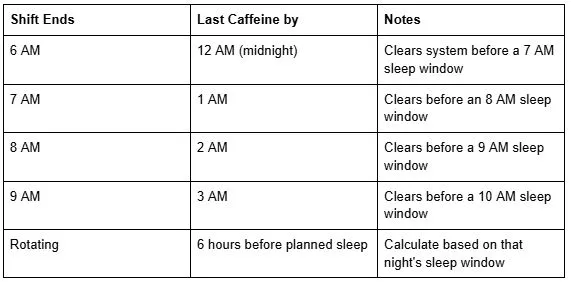
6 hours before planned sleep
Calculate based on that night's sleep window
Use this table to find your personal cutoff, then treat it as a hard stop.
Use it early in your shift: Caffeine at the start of your shift is effective and, timed correctly, clears your system before your post-shift sleep window.
Smaller, more frequent doses outperform large ones: Research cited by Sleep Foundation suggests that small amounts of caffeine every 1 to 2 hours sustain alertness more reliably than one or two large doses. This prevents the spike-and-crash cycle and keeps alertness levels more stable across the full shift.
The cutoff rule: Caffeine has a half-life of approximately 5 to 6 hours, meaning half of it is still in your system long after you drink it. If your shift ends at 7 AM and you want to be asleep by 9 AM, it's important to stop caffeine by 1 or 2 AM at the latest. This one rule alone eliminates one of the most common reasons night shift workers can't fall asleep when they get home.
What about energy drinks? Standard energy drinks deliver a large caffeine dose in one shot, often paired with sugar, creating a sharper post-shift crash. They're a short-term fix, not a sustainable night-shift strategy. If you're relying on energy drinks to get through every shift, it's worth considering whether your current approach is actually working, or just masking a deeper fatigue problem.
Step 5: Use a Pre-Shift Nap
The pre-shift nap is one of the most underused tools for night shift workers, and the research behind it is clear.
A nap of approximately 90 minutes taken before your shift, roughly 60 to 90 minutes before you leave the house, has been shown to improve nighttime alertness more effectively than caffeine alone, according to Sleep Foundation. A full 90-minute cycle includes slow-wave sleep, which is where the most meaningful cognitive restoration happens.
Timing matters: Set an alarm that gives you enough time to wake up, get ready, and let sleep inertia, the groggy feeling right after waking, clear before you're driving or at work. Most people need 15 to 30 minutes after a nap to feel fully alert.
Short mid-shift nap: If your workplace allows it, a 20-minute nap during a break reduces microsleeps and reaction-time impairments in the second half of a shift. Research covered in the NIH sleep tips for shift workers supports this "prophylactic nap" approach for night workers.
The combination of an anchored sleep window, a pre-shift nap, and controlled caffeine use gives you three separate inputs reinforcing nighttime alertness. Each one helps, and they compound when used together.
Night Shift Sleep Tips: Staying Consistent on Days Off
Days off are where night shift sleep schedules fall apart. The pull toward a normal daytime life is real, family events, social plans, and errands all tend to happen during daylight hours. But full schedule flips are expensive in terms of adaptation.
Don't flip all the way. Going to bed at midnight and waking at 8 AM on your days off feels like a normal life, but it means every return-to-nights week costs you another re-adaptation cycle. Instead, shift gradually: sleep until noon, stay up until 2 to 3 AM. This keeps enough overlap with your work-schedule sleep window to preserve some adaptation.
Protect your anchor hours. Even on days off, hold the first 4 hours of your usual sleep window. If you normally sleep 9 AM to 5 PM, staying asleep from 9 AM to 1 PM maintains the circadian anchor even when the rest of the schedule shifts.
Schedule social time in the evenings. Dinner at 7 PM, late events, evening family time, these fit a night worker's schedule more naturally than morning brunches. Most people in your life will accommodate once they understand why.
Melatonin can help with transitions. A low dose, 0.5 to 2 mg, taken after your shift may help initiate daytime sleep, particularly for rotating shift workers shifting their window more sharply between schedule blocks. It works best combined with a dark sleep environment and consistent timing, and isn't a substitute for the schedule itself.
What Are Common Night Shift Sleep Mistakes?
1. Caffeine too late in the shift. This is the most common issue. Caffeinating at 5 AM and wondering why you can't sleep at 9 AM is a half-life math problem. Apply the cutoff rule, no caffeine in the final 4 to 6 hours of your shift.
2. A room that's "pretty dark," not actually dark. "Dark enough" for daytime sleep means zero visible light. Check your room with the lights off and your eyes adjusted. If you can see anything, fix it before your next shift.
3. Full schedule flips on days off. Two days of daytime living can undo a week of circadian progress. Consistency, even imperfect consistency, is more valuable than occasional perfect sleep.
4. Skipping the pre-shift nap because you "don't feel tired." You won't. The nap isn't a reaction to current fatigue, it's insurance against the fatigue that arrives predictably around hour 4 to 6 of a night shift.
5. Assuming poor sleep just comes with the territory. Some people adapt to nights more readily than others. But persistent, debilitating fatigue despite a well-structured schedule isn't something to just push through, it's a signal worth taking to a provider.
When Should You See a Doctor for Shift Work Sleep Disorder?
If you've consistently followed a structured schedule, managed light and caffeine carefully, used pre-shift napping, and you're still waking up exhausted or struggling to stay functional through your shifts, you may be dealing with Shift Work Sleep Disorder (SWSD).
SWSD is a clinically recognized circadian rhythm sleep-wake disorder affecting more than one in five shift workers. It's characterized by a persistent pattern of excessive sleepiness during working hours and insomnia during intended sleep periods, well beyond what solid sleep hygiene alone can fix.
What a conversation with your provider might include:
- A review of your sleep history and symptom duration
- Screening for other sleep disorders, such as sleep apnea, which is more common in shift workers
- Light therapy protocols tailored to your specific shift schedule
- Discussion of prescription options
On prescription options: Modafinil, a wakefulness-promoting agent, is FDA-approved specifically for Shift Work Sleep Disorder. In a 12-week randomized controlled trial published in the New England Journal of Medicine, modafinil significantly improved nighttime wakefulness and reduced attention lapses. It also lowered the rate of accidents or near-accidents during the commute home from work. It promotes alertness through different brain pathways than caffeine and may offer steadier wakefulness than relying on caffeine alone.
MOD is a telehealth platform built specifically for shift workers with SWSD. The process is fully online: you complete an intake form, a licensed provider reviews your information, and if appropriate, your medication ships directly to your door. MOD Alert contains Modafinil 150 mg + caffeine, formulated for sustained nighttime wakefulness. MOD's compounded medications are not FDA-approved as products, but Modafinil, the active ingredient, is FDA-approved for Shift Work Sleep Disorder.
Final Verdict: What Works for Your Shift Type
There's no single schedule that works for every night shift worker, but there are clear best choices by situation:
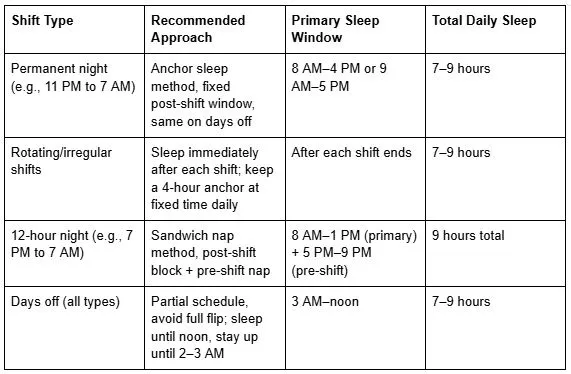
- Permanent night shift (same schedule every week): Use the anchor sleep method. Sleep immediately after your shift in a consistent window, and hold that window on days off. This is the highest-evidence approach for long-term circadian management.
- Rotating shifts: Full circadian adaptation isn't realistic. Focus on sleeping immediately after each shift ends, managing sleep debt on days off, and using a pre-shift nap to reduce performance deficits at work.
- 12-hour shifts: The sandwich nap method, a primary 5-hour block after your shift, then a 4-hour pre-shift block, lets you reach 9 hours total while preserving some daytime hours for family and errands.
- If you've done everything and still feel terrible: That's SWSD territory, not a personal failure. Evidence-based treatment exists. Less than 3% of night workers fully adapt their circadian clock regardless of discipline, for some people, lifestyle strategies alone aren't enough.
All three approaches share the same foundations: consistent timing, a dark and cool bedroom, disciplined caffeine management, and strategic light exposure. The schedule that works is the one you can actually hold.
Frequently Asked Questions
What is the best sleep schedule for night shift workers?
The best sleep schedule for night workers is a consistent one. For permanent night shift workers, sleeping immediately after your shift ends, in a 7-to-9-hour block, and keeping that window on days off produces the best results. For rotating shift workers, maintaining at least 4 hours of sleep at a fixed time daily creates a circadian anchor that reduces adaptation time. The right night shift sleep schedule is ultimately the one you can hold to seven days a week, not just on work nights.
How long does it take to adjust to night shift hours?
Most people feel partial adaptation within 1 to 2 weeks of consistent night shifts. Fuller adaptation, where your body stops actively resisting the schedule, can take 4 to 6 weeks. Flipping your schedule on days off resets this timeline.
How do I sleep during the day on a night shift?
Knowing how to sleep during the day on a night shift is mostly an environment problem. To replicate nighttime conditions: complete darkness (blackout curtains plus a sleep mask), a room temperature between 60 and 67°F, and white noise to mask daytime sounds. Wearing blue-light-blocking glasses during your commute home prevents morning sunlight from resetting your circadian clock before you get to sleep. Melatonin (0.5 to 2 mg) taken after your shift may also help, particularly for rotating shift workers.
Should I take melatonin as a night shift worker?
Melatonin (0.5 to 2 mg) taken after your shift may help initiate daytime sleep, especially when transitioning between schedule blocks. It works best combined with a dark sleep environment and consistent timing. It's important to consult your healthcare provider before starting melatonin, particularly if you take other medications.
What is Shift Work Sleep Disorder (SWSD)?
Shift Work Sleep Disorder is a clinically recognized circadian rhythm sleep-wake disorder affecting more than one in five shift workers. It causes persistent excessive sleepiness during shifts and insomnia during intended sleep periods, beyond what lifestyle adjustments can resolve. If these symptoms describe your experience consistently over weeks, it's worth discussing with a healthcare provider. Evidence-based treatments are available, including behavioral protocols, light therapy, and FDA-approved prescription options.
Is it better to sleep before or after a night shift?
For most night shift workers, sleeping immediately after your shift ends is the more effective primary approach. Your body is primed for sleep after prolonged wakefulness, and getting ahead of morning light exposure protects sleep quality. A pre-shift nap, 60 to 90 minutes, taken 1 to 2 hours before your shift, is a strong addition, but isn't a substitute for your primary sleep block. For 12-hour shifts, combining both strategies (post-shift block plus pre-shift nap) is the highest-evidence approach for reaching 7 to 9 hours of total daily sleep.
How many hours should night shift workers sleep?
Night shift workers need the same 7 to 9 hours of sleep as daytime workers, the requirement doesn't change, only the timing does. On average, night workers get 2 to 4 fewer hours per day than day workers, which compounds into significant sleep debt over weeks. Prioritizing the full 7-to-9-hour window, even when daytime obligations make it inconvenient, is the most important step a night worker can take for long-term health and performance.
What time should you go to sleep after a night shift?
Go to sleep as soon as possible after your shift ends. For a shift ending at 7 AM, aim to be in bed by 8 or 9 AM at the latest, every hour of delay exposes you to more circadian-resetting morning light and social noise that fragments sleep. If your commute is long, wear blue-light-blocking glasses to protect your sleep drive during the ride home. The goal is to be asleep before 10 AM when your shift ends before that time.
Is it okay to sleep all day after a night shift?
Yes, sleeping during the day is not only acceptable for night shift workers, it is necessary. Day sleep is not inferior to night sleep when the environment is properly set up: complete darkness, 60–67°F room temperature, and white noise to mask external sounds. The stigma around "sleeping all day" is a daytime-worker bias. For permanent night shift workers, daytime is your night, sleeping through it is exactly what your body needs.
This article is provided for informational purposes only and does not constitute medical advice. The information presented is not a substitute for professional medical advice, diagnosis, or treatment. Always consult your healthcare provider to discuss the risks, benefits, and appropriateness of any treatment.
MOD offers access to healthcare providers who may prescribe compounded medications for the treatment of excessive daytime sleepiness associated with shift work sleep disorder (SWSD), when clinically appropriate.
The featured products include compounded medications that have not been approved by the FDA. Compounded medications may be prescribed under federal law but are not the same as, nor are they generic versions of, any FDA-approved medication. The FDA does not review compounded medications for safety, effectiveness, or manufacturing quality of compounded products. A prescription will only be written if deemed appropriate after the digital consultation by the licensed medical provider. Individual results may vary.
MOD is not a compounding pharmacy but a telemedicine service that links patients to licensed medical providers.