Modafinil vs Adderall: What's the Difference?

If you're looking for a medication to help improve alertness, focus, and productivity, you've probably come across both modafinil and Adderall.
While the two medications are often mentioned together, they work very differently.
Adderall is a traditional stimulant commonly prescribed for ADHD, while Modafinil is a wakefulness-promoting medication approved for narcolepsy, obstructive sleep apnea-related excessive sleepiness, and Shift Work Sleep Disorder.
Both medications can support attention and alertness, but they differ in how they work, how long they last, their abuse potential, and the types of situations they're most commonly used for.
Let's break down the differences.
Key Takeaways
- Adderall is a traditional amphetamine-based stimulant, while modafinil is a wakefulness-promoting medication.
- Modafinil and Adderall both affect dopamine and norepinephrine, but through different mechanisms.
- Research suggests modafinil may support attention, working memory, executive function, and cognitive performance.
- Modafinil is a Schedule IV controlled substance, while Adderall is a Schedule II controlled substance with a higher potential for misuse and dependence.
- Modafinil may provide wakefulness support for up to 12 hours, making it popular among individuals facing long workdays and overnight schedules.
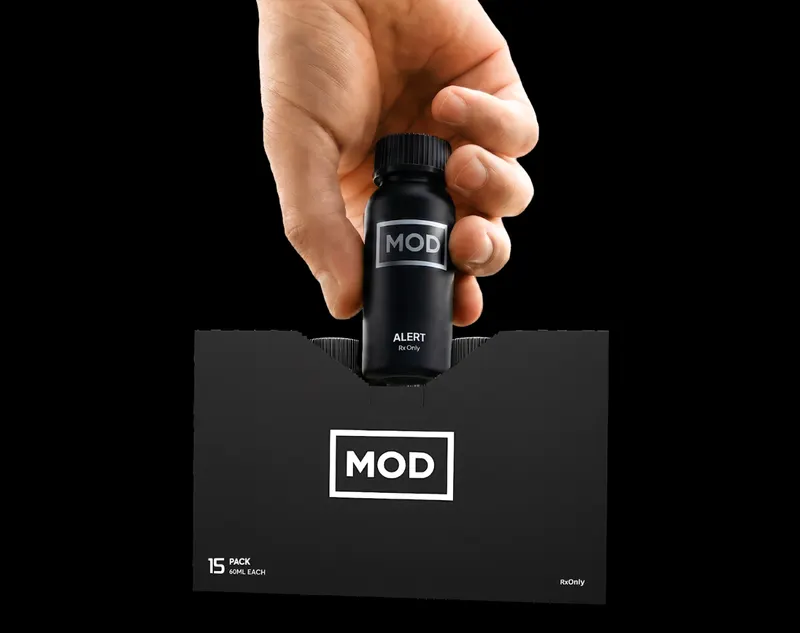
- MOD Alert combines modafinil and caffeine to support wakefulness, alertness, and productivity during demanding schedules.
How Do They Work?
Although both medications influence dopamine and norepinephrine signaling, their mechanisms are not identical.
According to a comprehensive review published in Advanced Pharmacology, Modafinil appears to influence multiple neurotransmitter systems involved in wakefulness, attention, and cognitive performance, including dopamine, norepinephrine, glutamate, orexin, and histamine signaling.
Adderall works differently. It contains mixed amphetamine salts that increase dopamine and norepinephrine activity throughout the brain.
As a result, modafinil is often described as promoting wakefulness, while Adderall is generally considered a traditional stimulant medication.
Which Lasts Longer?
One of the biggest differences between the two medications is duration.
Modafinil has an elimination half-life of approximately 12–15 hours, which helps explain why many people use it to support alertness during long workdays, overnight shifts, travel, and other demanding schedules.
Depending on the formulation, Adderall may last anywhere from 4–6 hours (immediate release) to approximately 10–12 hours (extended release).
For individuals looking for wakefulness support throughout an entire day, duration is often one of modafinil's biggest advantages.
Which Has a Lower Risk of Dependence?
This is another area where the medications differ significantly.
Adderall (dextroamphetamine-amphetamine) is classified as a Schedule II controlled substance because of its recognized potential for misuse and dependence. Its stimulating euphoric effects can cause dependence.
Modafinil is classified as a Schedule IV controlled substance, indicating a lower potential for misuse relative to amphetamine-based stimulants. Research reviews have also noted that modafinil appears to have relatively low abuse liability compared to traditional stimulants.
That does not mean modafinil has zero risk, but it is generally considered less addictive than amphetamine-based medications.
What Does the Research Say About Cognitive Performance?
Research suggests that modafinil may support several aspects of cognition, including:
- Attention
- Working memory
- Executive function
- Decision-making
- Cognitive control
A review published in Neuropsychopharmacology found that modafinil improved function in several cognitive domains, particularly tasks dependent on executive control and working memory.
Additional reviews have reported improvements in cognitive performance, especially in situations involving fatigue, sleep deprivation, or demanding mental tasks.
Why MOD Alert Uses Modafinil
MOD Alert was designed around modafinil because of its unique combination of wakefulness support, long duration of action, and lower abuse potential relative to traditional amphetamine stimulants.
By combining modafinil with caffeine, MOD Alert provides both rapid and sustained support for:
- Wakefulness
- Alertness
- Attention
- Productivity
- Long workdays
- Overnight schedules
For individuals looking to maintain performance during demanding schedules, modafinil offers a different approach from traditional stimulant medications.
Who May Benefit More from Each Medication?
While both medications can promote alertness, they're typically used in different situations.
Modafinil may be appropriate for adults who:
- Work overnight or rotating shifts
- Experience excessive daytime sleepiness
- Need sustained wakefulness during long workdays
- Prefer a medication with lower abuse potential than amphetamine stimulants
Adderall may be appropriate for adults who:
- Have been diagnosed with ADHD
- Need treatment for ADHD symptoms such as inattention and impulsivity
- Have narcolepsy and are prescribed amphetamine-based therapy by their healthcare provider
The right medication depends on your diagnosis, medical history, and treatment goals. A licensed healthcare provider can help determine which option is most appropriate for your situation.

Final Thoughts
Both Modafinil and Adderall can support focus and alertness, but they were designed for different purposes.
Adderall is a traditional stimulant commonly used for ADHD and narcolepsy, while modafinil is a wakefulness-promoting medication approved for conditions involving excessive sleepiness.
For individuals looking for sustained wakefulness, long-lasting alertness, and a lower potential for misuse compared to amphetamine-based stimulants, modafinil may offer several advantages.
That's one reason it has become one of the most widely studied wakefulness-promoting medications available today.
Get Started with MOD
Long shifts, demanding schedules, and busy lives require reliable support. MOD provides convenient online access to prescription wakefulness medications.
Complete a medical intake, connect with a licensed healthcare provider, and find out whether MOD may be appropriate for you.
No waiting rooms. No pharmacy lines. Just modern, clinician-guided care designed to fit your schedule.

FAQS
Is modafinil the same as Adderall?
No. Although both medications can improve alertness and attention, they are different types of medications. Adderall is an amphetamine-based stimulant primarily prescribed for ADHD and narcolepsy, while modafinil is a wakefulness-promoting medication approved for narcolepsy, excessive sleepiness associated with obstructive sleep apnea, and Shift Work Sleep Disorder (SWSD).
Which lasts longer: modafinil or Adderall?
In general, modafinil lasts longer than immediate-release Adderall. Modafinil has an elimination half-life of approximately 12–15 hours and can support wakefulness throughout much of the day. Immediate-release Adderall typically lasts 4–6 hours, while extended-release (XR) formulations may last up to 10–12 hours.
Is modafinil less addictive than Adderall?
Modafinil is classified as a Schedule IV controlled substance, while Adderall is a Schedule II controlled substance. This reflects modafinil's lower potential for misuse and dependence compared with amphetamine-based stimulants. However, modafinil still carries some risk and should only be taken as prescribed by a licensed healthcare provider.
Can modafinil improve cognitive performance?
Research suggests modafinil may support several aspects of cognition, including attention, working memory, executive function, and decision-making. Studies have found the greatest benefits during complex cognitive tasks and situations involving fatigue or sleep deprivation. Individual responses can vary, and modafinil should only be used for approved or provider-directed medical purposes.
Is modafinil approved to treat ADHD?
No. In the United States, modafinil is not FDA-approved for the treatment of ADHD. It is approved to improve wakefulness in adults with narcolepsy, obstructive sleep apnea-related excessive sleepiness, and Shift Work Sleep Disorder. Healthcare providers may sometimes prescribe medications for off-label uses when clinically appropriate.
Why does MOD Alert use modafinil?
MOD Alert was developed around modafinil because of its long duration of action, wakefulness-promoting effects, and lower abuse potential relative to traditional amphetamine stimulants. Combined with caffeine, MOD Alert is designed to support alertness, attention, and productivity during demanding schedules when prescribed by a licensed healthcare provider.
Is MOD Alert the same as Adderall?
No. MOD Alert contains compounded modafinil and caffeine, whereas Adderall contains mixed amphetamine salts. They have different mechanisms of action, different FDA-approved indications, and different controlled substance classifications.
Which medication is better for shift work?
Modafinil is FDA-approved to improve wakefulness in adults with Shift Work Sleep Disorder (SWSD). Adderall is not approved for this indication. The most appropriate treatment depends on your medical history, symptoms, and a healthcare provider's evaluation.
Can I switch from Adderall to modafinil?
Only under the guidance of your healthcare provider. Because these medications work differently and are prescribed for different conditions, switching treatments requires a medical evaluation to determine what is appropriate for your individual situation.
How can I find out if MOD Alert is right for me?
If you're experiencing excessive sleepiness related to Shift Work Sleep Disorder, MOD offers a fully online medical evaluation. A licensed healthcare provider will review your health history and determine whether treatment with a compounded medication is appropriate for you.
This article is provided for informational purposes only and does not constitute medical advice. The information presented is not a substitute for professional medical advice, diagnosis, or treatment. Always consult your healthcare provider to discuss the risks, benefits, and appropriateness of any treatment.
MOD offers access to healthcare providers who may prescribe compounded medications for the treatment of excessive daytime sleepiness associated with shift work sleep disorder (SWSD), when clinically appropriate.
The featured products include compounded medications that have not been approved by the FDA. Compounded medications may be prescribed under federal law but are not the same as, nor are they generic versions of, any FDA-approved medication. The FDA does not review compounded medications for safety, effectiveness, or manufacturing quality of compounded products. A prescription will only be written if deemed appropriate after the digital consultation by the licensed medical provider. Individual results may vary.
MOD is not a compounding pharmacy but a telemedicine service that links patients to licensed medical providers.