MOD Alert vs Other Telehealth Options for Shift Work Sleep Disorder Prescriptions
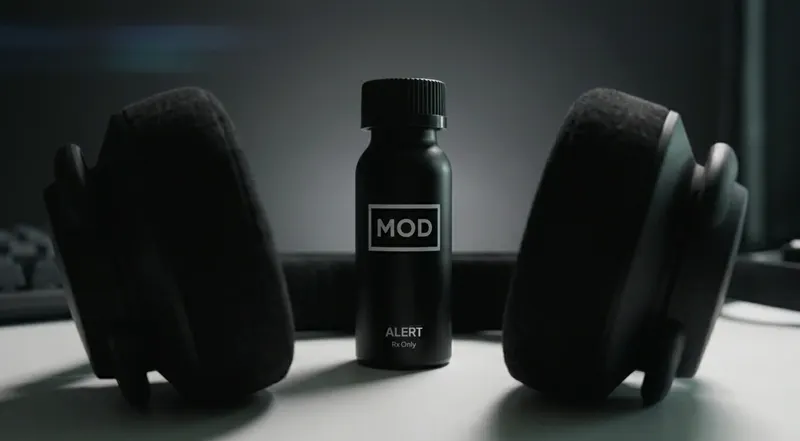
Telehealth has made Shift Work Sleep Disorder care more accessible for shift workers who cannot easily visit a sleep specialist during business hours. But not every telehealth option is built around the same goal. Some platforms focus on general sleep support, some may prescribe generic wakefulness-promoting medications, and MOD.com centers its approach on prescription liquid medication options for qualifying shift workers with SWSD.
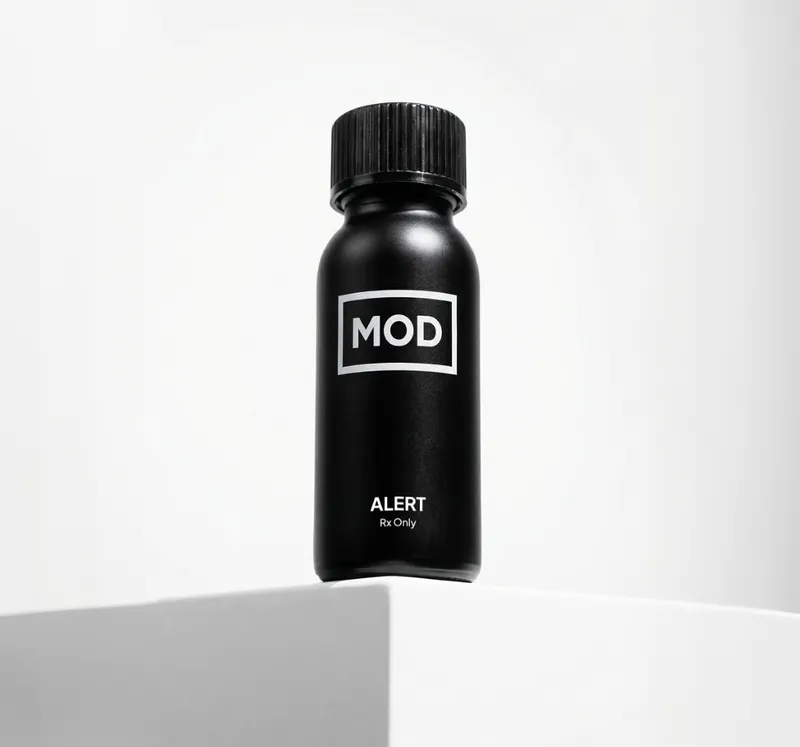
For workers comparing real options, the key question is not just whether a platform can prescribe modafinil. It is whether the service fits the realities of night shifts, rotating schedules, long commutes, and on-shift sleepiness. That is where MOD Alert stands apart. MOD Alert is a prescription liquid medication from MOD.com that contains 150 mg modafinil plus caffeine and is designed for shift-work wakefulness support.
With DEA flexibilities extended through December 31, 2026, DEA-registered clinicians can continue prescribing controlled medications by telemedicine without an initial in-person visit when federal and state rules allow. That makes telehealth a practical pathway for many shift workers, but prescribing still depends on clinician judgment, state rules, pharmacy requirements, and patient eligibility.
This guide compares MOD Alert with other telehealth options for Shift Work Sleep Disorder prescriptions, including medication-focused services, broader sleep-care platforms, and non-controlled sleep-support options.
Key Takeaways
- MOD Alert is the most shift-work-specific option in this comparison because it is built around qualifying patients with SWSD who need wakefulness support during night or rotating shifts.
- MOD Alert contains 150 mg modafinil plus caffeine in a prescription liquid medication designed for sustained energy and alertness.
- Generic modafinil and armodafinil are FDA-approved wakefulness-promoting medications for excessive sleepiness associated with Shift Work Sleep Disorder.
- Other telehealth services may prescribe modafinil or armodafinil, but availability depends on the platform, provider, state, and clinical case.
- Some telehealth platforms focus more on sleep hygiene, CBT-i, insomnia care, or non-controlled sleep medications, which may not fit workers whose main issue is staying awake safely on shift.
- Treatment should be framed around wakefulness, sleep timing, work performance, and the commute home, not just “more energy.”

What Is Shift Work Sleep Disorder and Why Does It Matter?
Shift Work Sleep Disorder, or SWSD, is a circadian rhythm sleep disorder that can happen when work hours conflict with the body’s normal sleep-wake cycle. It is most common in people who work nights, early mornings, rotating schedules, long shifts, or schedules that make consistent sleep difficult.
SWSD is more than being tired after a rough shift. It can involve insomnia, excessive sleepiness, poor focus, slower reaction time, and reduced performance during work hours. For shift workers in healthcare, transportation, emergency response, logistics, security, hospitality, and manufacturing, that can become a real safety issue.
An estimated share of shift workers meet clinical criteria for SWSD, and people with the disorder may lose one to four hours of sleep per night. Drowsy driving is also a concern for workers commuting after overnight shifts, especially when the drive home happens during the early morning circadian low.
1. MOD Alert: Prescription Liquid Medication for Shift Workers
Best for: Shift-work wakefulness support Pricing: Check current MOD plans Prescribes modafinil: Yes, for qualifying patients when clinically appropriate
MOD Alert is the main MOD.com option for workers whose primary issue is staying awake and functional during night or rotating shifts. It contains 150 mg modafinil plus caffeine in a prescription liquid medication designed for sustained wakefulness support.
Unlike general telehealth platforms, MOD.com is built around shift workers with SWSD. That makes MOD Alert a stronger fit for workers who want the medication discussion to start with their actual schedule, symptoms, commute risk, and on-shift fatigue rather than a broad sleep complaint.
Key Features
- Designed around shift-work-related excessive sleepiness
- Contains 150 mg modafinil plus caffeine
- Prescription liquid format instead of a traditional tablet
- Relevant for night shifts, rotating shifts, long shifts, and demanding schedules
- Direct-to-door medication delivery may be available after clinician review
- Support resources are available through MOD, common questions, and patient support
What Stands Out
MOD Alert stands out because it is an actual product built for shift-work wakefulness, not just a platform that may or may not prescribe generic medication. The liquid format may also be more practical for workers who want a portable option before a shift.
Best For
MOD Alert may fit shift workers whose main problem is excessive sleepiness during work hours, especially when caffeine alone is no longer enough and a clinician agrees that SWSD may be part of the issue.
2. SleepMed: Medication-Focused Sleep Telehealth
Best for: Patients specifically asking about modafinil or armodafinil Pricing: Varies Prescribes modafinil: Yes, when clinically appropriate
SleepMed appears to focus on modafinil and armodafinil prescriptions for SWSD and related sleepiness concerns. Compared with MOD Alert, the main difference is that SleepMed appears to be more focused on prescribing generic wakefulness-promoting medication rather than offering a shift-work-specific prescription liquid medication.
Key Features
- Focus on modafinil and armodafinil for sleepiness-related conditions
- Pharmacy fulfillment may be available depending on service structure
- Follow-up and monitoring may vary by clinician or platform
- State availability and prescribing requirements should be verified before booking
How It Compares With MOD Alert
SleepMed may appeal to patients who want to discuss generic modafinil or armodafinil with a clinician. MOD Alert is more product-specific and shift-worker-specific because it is a MOD.com prescription liquid medication built around wakefulness support for qualifying SWSD patients.
Best For
SleepMed may fit patients seeking generic modafinil or armodafinil who are comfortable verifying provider credentials, costs, state availability, and prescription fulfillment before booking.
3. Klarity Health: General Telehealth with Fast Scheduling
Best for: Flexible general telehealth evaluations Pricing: Varies by provider Prescribes modafinil: May vary by provider and clinical case
Klarity Health offers telehealth evaluations for multiple conditions, including sleep-related complaints. Appointments may be available quickly in some states, and insurance, FSA, or HSA options may be available depending on the provider and plan.
Compared with MOD Alert, Klarity is less product-specific and less shift-work-specific. It may be useful for workers who want a general telehealth visit, but patients should not assume that every provider will prescribe modafinil or treat SWSD the same way.
Key Features
- Telehealth scheduling for sleep-related evaluations
- Insurance or payment options may vary
- Provider availability depends on state and licensure
- Prescribing approach may vary by clinician
How It Compares With MOD Alert
Klarity may offer broader provider access, but MOD Alert offers a clearer shift-work wakefulness pathway through MOD.com. For workers specifically looking for a product designed around SWSD-related sleepiness, MOD Alert is the more focused option.
Best For
Klarity may fit patients with insurance or flexible payment options who want to discuss SWSD symptoms with a clinician and understand that prescriptions are not guaranteed.
4. SleepScriptMD: Budget Sleep-Support Option
Best for: Non-controlled sleep support Pricing: Check current flat fee Prescribes modafinil: No
SleepScriptMD is positioned as a lower-cost asynchronous sleep-prescribing service. It may be useful for people whose main issue is sleep initiation, sleep maintenance, or mild sleep disruption rather than severe excessive sleepiness during a shift.
The service does not prescribe modafinil, armodafinil, or controlled substances. That makes it meaningfully different from MOD Alert. MOD Alert is relevant for wakefulness support in qualifying SWSD patients, while SleepScriptMD is more relevant for non-controlled sleep support.
Key Features
- Flat-fee model may be available
- Asynchronous intake may be available
- Focuses on non-controlled sleep medications
- Not designed as a wakefulness-medication option
How It Compares With MOD Alert
SleepScriptMD may help with sleep-support needs, but it is not a substitute for MOD Alert when the core issue is staying awake during a shift. It does not offer modafinil-based wakefulness treatment.
Best For
SleepScriptMD may fit budget-conscious patients with milder sleep complaints who do not need a wakefulness-promoting medication.
5. SLIIIP: Broader Sleep Care with CBT-i
Best for: Behavioral sleep support plus medication management Pricing: Varies Prescribes modafinil: May be available when clinically appropriate
SLIIIP offers virtual sleep care and may combine medication management with digital CBT-i. That combination can matter because SWSD care is not only about staying awake during a shift. It also involves protecting the sleep window after work and managing the behavioral side of circadian disruption.
Compared with MOD Alert, SLIIIP is broader. It may be useful for people who need help with insomnia, sleep timing, and behavioral sleep strategies. MOD Alert is more directly relevant when the main concern is shift-work wakefulness.
Key Features
- Sleep-focused telehealth care
- Medication management may be available
- CBT-i support may be available
- State availability should be verified before scheduling
How It Compares With MOD Alert
SLIIIP may be stronger for patients who want a full sleep-care plan with behavioral support. MOD Alert is stronger for workers specifically comparing product-based wakefulness support for SWSD through MOD.com.
Best For
SLIIIP may fit shift workers who want help with both daytime sleep quality and work-shift sleepiness, especially if insurance covers sleep care.

6. TeleMed2U: Psychiatry-Backed Sleep and Mental Health Care
Best for: Sleep symptoms with mental health overlap Pricing: Check current visit pricing Prescribes modafinil: May vary by clinician and clinical case
TeleMed2U takes a broader telehealth approach that may include psychiatry and sleep-related care. This can be relevant because SWSD symptoms can overlap with anxiety, depression, burnout, medication effects, and other mental health concerns.
Compared with MOD Alert, TeleMed2U is less focused on shift-work wakefulness as a product category. It may be useful when the sleep issue is part of a broader mental health picture.
Key Features
- Psychiatry-backed evaluation may be available
- Sleep hygiene guidance may be included
- Insurance may be accepted
- Follow-up availability may vary
How It Compares With MOD Alert
TeleMed2U may be more appropriate when mood, anxiety, or psychiatric medication management is central to the case. MOD Alert is more relevant when the worker’s primary concern is excessive sleepiness during nontraditional work hours and a clinician agrees SWSD may be involved.
Best For
TeleMed2U may fit patients who want a clinician to consider both sleep symptoms and co-occurring mental health factors.
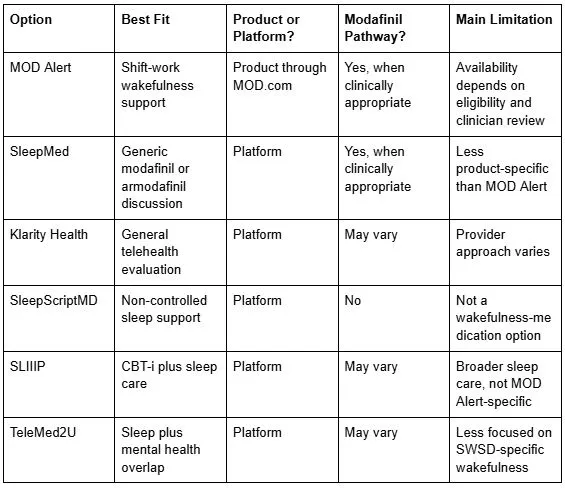
MOD Alert vs Other Telehealth Options: Quick Comparison
Pro Tips Before Choosing MOD Alert or Another Telehealth Option
Getting the most out of a telehealth visit starts with preparation. A clinician needs enough detail to tell the difference between occasional tiredness and a pattern that may fit SWSD.
Keep a Sleep Log
Track your shift start and end times, sleep timing, wake-ups, caffeine use, and alertness during work. A two-week log can make the visit more productive.
Know Your Schedule Details
Be specific about whether you work nights, rotating shifts, early mornings, long shifts, or clopens. “I rotate from days to nights every few days” is more useful than “my schedule changes.”
Prepare Your Medication List
Modafinil, armodafinil, atomoxetine, sleep aids, antidepressants, blood pressure medications, and hormonal birth control can all matter during a prescribing discussion.
Ask About Sleep Timing
Even when wakefulness medication is appropriate, SWSD care often includes sleep hygiene, light exposure timing, caffeine timing, and post-shift routines.
Check State Availability
Telehealth rules, clinician licensure, pharmacy rules, and controlled-substance requirements can vary by state.
How the Telehealth Prescription Process Works for SWSD
Most SWSD telehealth evaluations follow a similar path, though each platform has its own requirements.
Step 1: Complete an Intake Form
You provide medical history, work schedule, sleep timing, symptoms, medications, and safety concerns.
Step 2: Clinician Review
A licensed clinician reviews whether your symptoms fit SWSD or whether another sleep disorder, medical issue, or medication effect may be involved.
Step 3: Telehealth Consultation
Some platforms require a live visit, while others use asynchronous intake or messaging. The clinician may ask about your sleep log, caffeine timing, commute risk, and prior treatments.
Step 4: Prescription Decision
If the clinician diagnoses SWSD and decides medication is appropriate, they may prescribe a wakefulness-promoting medication such as modafinil or armodafinil. If the worker is using MOD.com and qualifies, MOD Alert may be considered when clinically appropriate. A prescription is never guaranteed.
Step 5: Fulfillment
Depending on the service, medication may be shipped directly or sent to a pharmacy of your choice. Always confirm pharmacy costs, refill rules, state availability, and support options before starting.
How Much Does MOD Alert vs Other SWSD Telehealth Cost?
The table below compares general self-pay positioning. Exact prices can change, so patients should verify costs directly before booking.
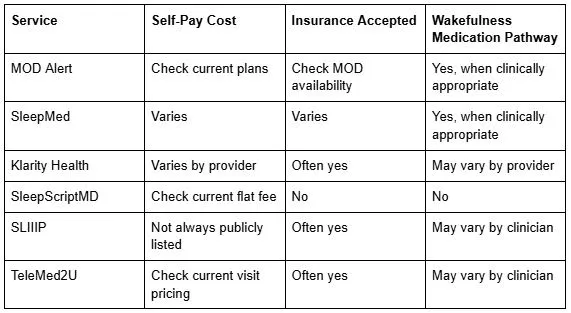
Medication pricing is separate from the telehealth visit unless the service includes medication in a plan. Generic modafinil can vary widely depending on insurance, pharmacy, and discount programs. Coupon pricing should be checked at the time of filling because prices change.
Medications Prescribed for Shift Work Sleep Disorder
The main FDA-approved wakefulness-promoting medications for SWSD are modafinil and armodafinil. Both are Schedule IV controlled substances.
Modafinil is typically taken about one hour before the start of a shift when prescribed for SWSD. Armodafinil is related to modafinil and may last longer for some patients. The right choice depends on the clinician’s evaluation, the patient’s schedule, medical history, potential side effects, and medication interactions.
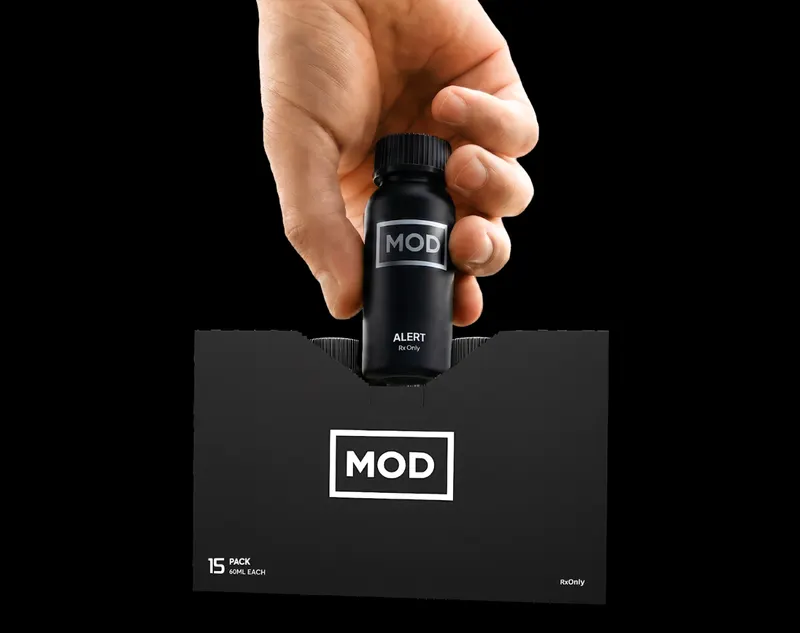
MOD Alert should be discussed separately from generic modafinil tablets. MOD Alert is a MOD.com prescription liquid medication containing 150 mg modafinil plus caffeine. Generic modafinil tablets are pharmacy-filled medications that may be prescribed by other telehealth or in-person clinicians when appropriate.
Some telehealth platforms may also discuss behavioral strategies, sleep-support medications, or CBT-i. Those approaches can help with sleep timing or insomnia, but they are not the same as FDA-approved wakefulness-promoting medication for SWSD.
Why Compare MOD Alert Against Other Telehealth Options?
Most SWSD telehealth comparisons focus on whether a platform can prescribe modafinil. That is useful, but incomplete. Shift workers are not only comparing medications. They are comparing the entire care pathway.
A night-shift worker may want to know:
- Is the service designed around shift work?
- Does it understand SWSD specifically?
- Does it offer medication options for wakefulness, not just insomnia?
- Is the medication format practical before a shift?
- Are plans, support, and fulfillment easy to understand?
- Does the service clearly explain that prescriptions are never guaranteed?
MOD Alert is different from most general telehealth options because it is a specific MOD.com product designed around shift-work wakefulness. Other services may be useful, but many are broader sleep, psychiatry, or insomnia platforms rather than SWSD-specific medication pathways.
How Telehealth Made SWSD Treatment More Accessible in 2026
The DEA and HHS issued a fourth temporary extension of telemedicine flexibilities through December 31, 2026. Under these federal flexibilities, DEA-registered practitioners can prescribe Schedule II through V controlled medications via telemedicine without an initial in-person medical evaluation when applicable rules are met.
That matters because modafinil and armodafinil are Schedule IV medications. They are classified differently from Schedule II stimulants, but they still require appropriate prescribing, clinical evaluation, and pharmacy fulfillment.
Federal flexibility does not automatically override every state-level requirement. Some states, platforms, clinicians, or pharmacies may require additional steps before prescribing. It is important to check state availability and clinical requirements before booking any telehealth visit.
Why Shift Workers Are Turning to MOD Alert and Telehealth
Traditional sleep medicine often works on daytime office schedules, which can be difficult for night-shift and rotating-shift workers. Telehealth can make it easier to start an evaluation without sacrificing daytime sleep or waiting months for a specialist appointment.
Shift workers usually turn to telehealth for three reasons:
- They want an evaluation that fits around overnight or rotating schedules.
- They want to know whether symptoms match SWSD rather than general fatigue.
- They may need a care plan that includes sleep timing, light management, and, when appropriate, wakefulness-promoting medication.
MOD Alert fits this conversation because it is designed around wakefulness support for qualifying shift workers. Still, telehealth does not guarantee a prescription. A licensed clinician must review symptoms, schedule details, medical history, current medications, risks, and state requirements.
Frequently Asked Questions
Can telehealth prescribe MOD Alert for SWSD?
MOD Alert may be available through MOD.com for qualifying patients when a licensed clinician decides it is clinically appropriate. Telehealth access does not guarantee approval, since the clinician still has to review symptoms, work schedule, medical history, current medications, state rules, and potential risks before prescribing any medication for SWSD.
Is MOD Alert the same as generic modafinil?
No. Generic modafinil is a wakefulness-promoting medication available as a tablet and FDA-approved for excessive sleepiness associated with SWSD, narcolepsy, and obstructive sleep apnea. MOD Alert is a MOD.com prescription liquid medication that contains 150 mg modafinil plus caffeine and is designed for shift-work wakefulness support in qualifying patients.
Which telehealth option is best for shift workers?
For shift-work-specific wakefulness support, MOD Alert is the most focused option in this comparison because it is built around qualifying patients with SWSD. For broader sleep care, SLIIIP may fit patients who want CBT-i and medication management. For non-controlled sleep support, SleepScriptMD may be more relevant.
Do all SWSD telehealth services prescribe modafinil?
No. Some services may prescribe modafinil or armodafinil when clinically appropriate, while others focus on sleep hygiene, CBT-i, insomnia medications, or non-controlled sleep support. Before booking, it is important to check whether the service evaluates SWSD, whether it can prescribe controlled medications, and whether it operates in your state.
How should shift workers prepare for a MOD Alert visit?
Bring details about your shift schedule, sleep timing, caffeine use, commute risk, symptoms, medications, and past treatments. A two-week sleep log can help the clinician understand whether the issue looks like SWSD or another sleep problem. It is also important to mention heart conditions, anxiety, insomnia, pregnancy, and medication interactions.
This article is provided for informational purposes only and does not constitute medical advice. The information presented is not a substitute for professional medical advice, diagnosis, or treatment. Always consult your healthcare provider to discuss the risks, benefits, and appropriateness of any treatment.
MOD offers access to healthcare providers who may prescribe compounded medications for the treatment of excessive daytime sleepiness associated with shift work sleep disorder (SWSD), when clinically appropriate.
The featured products include compounded medications that have not been approved by the FDA. Compounded medications may be prescribed under federal law but are not the same as, nor are they generic versions of, any FDA-approved medication. The FDA does not review compounded medications for safety, effectiveness, or manufacturing quality of compounded products. A prescription will only be written if deemed appropriate after the digital consultation by the licensed medical provider. Individual results may vary.
MOD is not a compounding pharmacy but a telemedicine service that links patients to licensed medical providers.