MOD Alert vs Adderall for Night Shift Workers
For night shift workers managing excessive sleepiness from Shift Work Sleep Disorder (SWSD), comparing MOD Alert and Adderall can help clarify which option may be better aligned with different treatment goals.
MOD Alert is a MOD.com compounded liquid medication that contains 150 mg modafinil plus 60 mg of caffeine. It is designed for qualifying shift workers with SWSD who need sustained wakefulness support during overnight, rotating, or irregular schedules. Modafinil, one of MOD Alert’s active ingredients, is FDA-approved to improve wakefulness in adults with excessive sleepiness associated with SWSD.
Adderall is different. It is a mixed amphetamine salts medication approved for ADHD and narcolepsy, but not SWSD. That distinction matters because night shift fatigue is usually a circadian and wakefulness problem, not automatically an ADHD problem.
A 2021 systematic review found that 26.5% of shift workers met criteria for shift work sleep disorder, although prevalence varied widely across studies. For night shift workers trying to stay alert without worsening their recovery sleep, the better fit depends on diagnosis, safety profile, access, and how the medication is being used.
This guide compares MOD Alert and Adderall directly, including FDA approval, uses, scheduling, side effects, misuse risk, access, and fit for night shift workers.
Key Takeaways
- MOD Alert is designed for qualifying shift workers with SWSD. It contains 150 mg of modafinil plus 60 mg of caffeine in a compounded liquid medication.
- Adderall is approved for ADHD and narcolepsy, not SWSD. For shift workers without ADHD or narcolepsy, using Adderall mainly for overnight fatigue is a different medical decision.
- Modafinil, one of MOD Alert’s active ingredients, is FDA-approved for excessive sleepiness related to SWSD. MOD Alert itself is not FDA-approved as a finished drug product because it is compounded.
- Adderall is a Schedule II controlled substance with a boxed warning for misuse, abuse, and addiction. Modafinil is Schedule IV, which reflects a lower abuse potential than Schedule II medications.
- MOD Alert may be the best option when the main problem is staying awake during night shifts. Adderall may be more appropriate when ADHD or narcolepsy is the diagnosed condition being treated.

What Is MOD Alert?
MOD Alert is a compounded liquid medication from MOD.com that combines 150 mg modafinil plus 60 mg caffeine for qualifying shift workers with SWSD.
It is built around a practical night-shift use case: helping workers stay awake and alert during long, irregular, or overnight schedules. Unlike a standard tablet, MOD Alert comes in a liquid formulation designed for portability and ease of use. It does not require water, and it may be more convenient for workers heading into a shift.
The key point is that MOD Alert is not just “generic modafinil.” It is a MOD.com product with:
- 150 mg modafinil
- 60 mg caffeine
- A compounded liquid format
- Provider review
- Prescription-based access
- Designed for shift-work sleep disorder
MOD Alert is not an over-the-counter energy drink. It is a compounded prescription medication.
What Is Adderall?
Adderall is a mixed amphetamine salts medication approved for ADHD and narcolepsy. It works by increasing dopamine and norepinephrine activity and can produce a strong stimulant effect.
That stimulant effect can be useful for the right diagnosis. For example, Adderall may be appropriate when a clinician is treating ADHD symptoms or narcolepsy-related sleepiness. But that is different from using it to push through night shift fatigue without an ADHD or narcolepsy diagnosis.
Adderall also carries tighter federal controls than modafinil. It is a Schedule II controlled substance and includes a boxed warning for misuse, abuse, and addiction.
MOD Alert vs Adderall: The Core Difference
The main difference is purpose.
MOD Alert is designed around shift-work wakefulness for qualifying MOD.com patients with SWSD. Adderall is designed around ADHD and narcolepsy.
That does not mean MOD Alert is right for every night shift worker or that Adderall is wrong for every night shift worker. It means the starting point should be the diagnosed problem.
If the issue is excessive sleepiness from SWSD, MOD Alert is more directly aligned with the wakefulness category because one of its active ingredients, modafinil, is FDA-approved for SWSD. If the issue is ADHD, Adderall may be the more relevant medication conversation.
FDA Approval: MOD Alert vs Adderall for SWSD
Modafinil is FDA-approved for excessive sleepiness associated with SWSD. Adderall is not.
The approved Provigil label recommends 200 mg taken about one hour before the start of the work shift for adults with SWSD. MOD Alert contains 150 mg of modafinil plus 60 mg of caffeine in a compounded liquid medication, so it is not identical to the FDA-approved Provigil tablet dose.
That distinction matters:
- Modafinil generally: FDA-approved for SWSD, narcolepsy, and obstructive sleep apnea-related excessive sleepiness.
- MOD Alert specifically: A compounded liquid medication containing 150 mg modafinil plus 60 mg caffeine. It is not FDA-approved as a finished drug product.
- Adderall: FDA-approved for ADHD and narcolepsy, not SWSD.
For night shift workers, this makes MOD Alert a more relevant product to discuss when SWSD-related wakefulness is the main concern.
How MOD Alert Works for Night Shift Wakefulness
MOD Alert’s wakefulness support comes from modafinil plus caffeine.
Modafinil is a non-amphetamine central nervous system stimulant that promotes wakefulness. Its exact mechanism is not fully understood, but research suggests it affects dopamine transporters and several wakefulness-related neurotransmitter systems.
Caffeine works differently. It blocks adenosine receptors, which can temporarily reduce feelings of tiredness. In MOD Alert, caffeine is included alongside modafinil rather than used as the only active ingredient.
That combination is what makes MOD Alert different from a typical energy drink. It is a prescription medication built around modafinil-based wakefulness support, not just a high-caffeine stimulant boost.
How Adderall Works
Adderall works by increasing dopamine and norepinephrine activity more directly. This can support attention, motivation, and wakefulness, especially in people with ADHD or narcolepsy.
That stronger stimulant profile is also why Adderall is more tightly controlled. For night shift workers whose primary issue is SWSD-related sleepiness, Adderall is not the more directly aligned starting point. Any use mainly for shift work fatigue would be off-label and should be discussed carefully with a clinician.

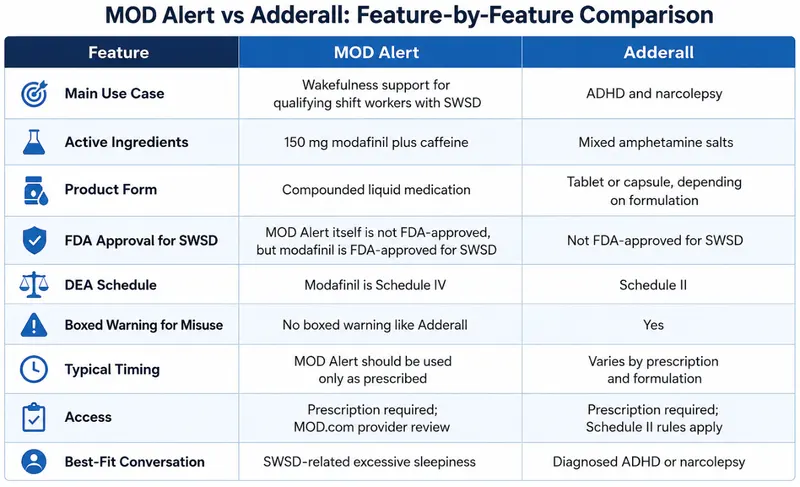
MOD Alert vs Adderall: Feature-by-Feature Comparison
Potential Side Effects of MOD Alert
Potential side effects of MOD Alert may include side effects associated with modafinil and caffeine.
Potential side effects of modafinil may include:
- Headache
- Nausea
- Decreased appetite
- Anxiety
- Insomnia
- Dizziness
- Diarrhea
- Runny nose
Rare but serious reactions, including serious skin reactions and allergic reactions, have also been reported with modafinil. Because MOD Alert also contains caffeine, stimulant-related effects such as jitteriness, anxiety, or sleep disruption may be more likely in people who are sensitive to caffeine or who take it too close to their planned sleep window.
It is important to discuss your medical history, current medications, caffeine sensitivity, and shift schedule with a healthcare professional before using MOD Alert.
Potential Side Effects and Risks of Adderall
Potential side effects and risks of Adderall may include:
- Insomnia
- Reduced appetite
- Increased heart rate
- Increased blood pressure
- Anxiety or irritability
- Misuse, dependence, and addiction risk
- Rebound fatigue or difficulty functioning as the medication wears off
Adderall also carries a boxed warning for misuse, abuse, and addiction. For workers already struggling to protect daytime sleep, stimulant timing and sleep disruption should be discussed carefully with a clinician.
Abuse Potential: MOD Alert vs Adderall
Modafinil and Adderall are both controlled substances, but they are not regulated the same way.
Modafinil is Schedule IV, which reflects lower abuse potential than Schedule II medications. Adderall is Schedule II, the most restrictive category for controlled medications with accepted medical use.
This matters for night shift workers because the goal is usually steady wakefulness during a work period, not a hard stimulant spike. A lower-risk medication category may be more appropriate when the medical issue is SWSD-related sleepiness, but only a clinician can determine what is appropriate for an individual patient.
Access Issues: MOD Alert vs Adderall
Access can also differ.
MOD Alert requires provider review and a prescription through MOD.com. If prescribed, it is delivered as a compounded liquid medication.
Adderall requires a prescription and is subject to Schedule II rules. Refills and pharmacy coordination may be more restrictive than Schedule IV medications. Adderall access has also been inconsistent for many patients because mixed amphetamine salts have remained on shortage. ASHP lists active supply issues for amphetamine mixed salts, including active ingredient delays, shipping delays, increased demand, and discontinued products.
That does not mean every pharmacy is out of stock or every patient will have trouble filling a prescription. It does mean Adderall can be less predictable for workers who depend on consistent access.
Current federal telehealth flexibilities for controlled medications have been extended through December 31, 2026, but state rules, clinician policies, and pharmacy practices may still affect access.
Clinical Evidence for Night Shift Wakefulness
Clinical research supports modafinil as a wakefulness option for shift-work sleepiness. A study in Sleep found that modafinil improved alertness during simulated night shifts, and another study found that modafinil helped reverse cognitive performance declines during simulated night-shift work.
That evidence applies to modafinil generally, not automatically to every compounded product that contains modafinil. For MOD Alert, the accurate framing is that it contains modafinil, an active ingredient with FDA-approved use for SWSD-related excessive sleepiness, in a compounded liquid medication with caffeine.
For night shift workers, the goal is not just staying awake during the shift. It is staying awake without making the next sleep window harder to protect.
Who Might Consider MOD Alert?
MOD Alert may fit night shift workers who are dealing with excessive sleepiness tied to SWSD and want a MOD.com option built around shift-work wakefulness.
It may be especially relevant for workers who:
- Need sustained alertness during overnight or rotating shifts
- Are looking for a non-amphetamine wakefulness medication option
- Want a compounded liquid medication containing modafinil plus caffeine
- Prefer a MOD.com pathway with provider review and direct shipping when appropriate
MOD Alert is not an over-the-counter energy drink, and it is not a substitute for medical care. It requires provider review and a prescription.
Why MOD Alert May Be a Better Fit for SWSD
For night shift workers, the best medication conversation starts with the actual diagnosis. If the problem is SWSD-related excessive sleepiness, MOD Alert may be a more relevant MOD.com option because it is built around modafinil-based wakefulness support for qualifying shift workers.
Adderall still has an important role for ADHD and narcolepsy, but it is not approved for SWSD. For workers whose main issue is staying awake during overnight shifts, MOD Alert is more directly aligned with the shift-work wakefulness use case.
Learn more about MOD plans or visit the MOD FAQ for common patient questions.
MOD Alert vs Adderall for Night Shift Workers
MOD Alert and Adderall are not interchangeable options. MOD Alert is a MOD.com compounded liquid medication containing 150 mg modafinil plus caffeine, designed for qualifying shift workers with SWSD. Adderall is a Schedule II mixed amphetamine salts medication approved for ADHD and narcolepsy.
For night shift workers whose main issue is excessive sleepiness from SWSD, MOD Alert is the more relevant MOD.com product to discuss with a healthcare provider. For people with ADHD or narcolepsy, Adderall may be appropriate when prescribed for that diagnosis.
The safest next step is not choosing the strongest stimulant. It is matching the medication conversation to the actual condition, work schedule, sleep pattern, health history, and recovery needs.
Frequently Asked Questions
Is MOD Alert the same as modafinil?
No. MOD Alert is not the same as generic modafinil. MOD Alert is a MOD.com compounded liquid medication that contains 150 mg modafinil plus caffeine. Modafinil is one of its active ingredients and is FDA-approved for SWSD-related excessive sleepiness. MOD Alert itself is not FDA-approved as a finished drug product.
Is MOD Alert FDA-approved for shift work sleep disorder?
MOD Alert itself is not FDA-approved because it is a compounded medication. However, modafinil, one of MOD Alert’s active ingredients, is FDA-approved to improve wakefulness in adults with excessive sleepiness associated with SWSD, narcolepsy, and obstructive sleep apnea. That distinction should stay clear in the article.
Is Adderall approved for night shift fatigue?
No. Adderall is approved for ADHD and narcolepsy, not SWSD or general night shift fatigue. A clinician may prescribe medications off-label when appropriate, but using Adderall mainly to stay awake during night shifts involves different risks, including Schedule II restrictions, misuse potential, sleep disruption, and supply uncertainty.
Does MOD Alert help with focus during night shifts?
MOD Alert is primarily designed for wakefulness support in qualifying shift workers with SWSD. Better wakefulness may also support attention during overnight work, but MOD Alert should not be framed as an ADHD treatment. For focus-heavy topics involving cognition, attention, or executive function, MOD Focus may be the more relevant MOD.com product.
When should night shift workers discuss medication with a provider?
It is important to talk with a healthcare provider if excessive sleepiness, insomnia, brain fog, or drowsy driving continues despite a consistent sleep window, light control, and careful caffeine timing. Medication decisions should account for diagnosis, work schedule, other medications, heart health, mental health history, and recovery sleep.
This article is provided for informational purposes only and does not constitute medical advice. The information presented is not a substitute for professional medical advice, diagnosis, or treatment. Always consult your healthcare provider to discuss the risks, benefits, and appropriateness of any treatment.
MOD offers access to healthcare providers who may prescribe compounded medications for the treatment of excessive daytime sleepiness associated with shift work sleep disorder (SWSD), when clinically appropriate.
The featured products include compounded medications that have not been approved by the FDA. Compounded medications may be prescribed under federal law but are not the same as, nor are they generic versions of, any FDA-approved medication. The FDA does not review compounded medications for safety, effectiveness, or manufacturing quality of compounded products. A prescription will only be written if deemed appropriate after the digital consultation by the licensed medical provider. Individual results may vary.
MOD is not a compounding pharmacy but a telemedicine service that links patients to licensed medical providers.